AEROSPACE SERVICES | EUROPE
Reducing shop-visit delay from repair-path dependencies
A Turnaround Path Constraint Model for aircraft-engine MRO
CLIENT DECISION Where could casting and heat-treatment dependencies delay aircraft-engine maintenance activity, and which intervention protects turnaround time?
Background
A European engine-maintenance provider needed to understand why planned shop visits could still be delayed despite adequate internal bay capacity. The study followed critical parts through inspection, repair approval, special processes, replacement supply and release to service.
240
ANNUAL SHOP VISITS
13
CRITICAL EXTERNAL RELATIONSHIPS
7
SPECIAL-PROCESS FACILITIES
4
EUROPEAN JURISDICTIONS
ILLUSTRATIVE ENGAGEMENT | The organisation, scope, figures, findings and conclusion below show how the service can be applied. They do not describe an actual client engagement.
RESEARCH DESIGN
Turnaround Path Constraint Model
Each shop visit was represented as a conditional path. Parts did not enter the same route: inspection findings determined whether they could be repaired, required a specialised process, needed approved data or had to be replaced from a constrained casting source.
01
Define visit archetypes
Group shop visits by engine family, work scope and probable finding.
02
Map conditional routes
Connect inspection outcomes to repair, special process or replacement paths.
03
Resolve approved capacity
Identify facilities with the required approval, capability and available slot.
04
Model turnaround effect
Apply queue time, transport, approval and replacement lead time to each path.
05
Protect the critical path
Select repair-route, spare-pool and contracting actions by visit archetype.
Evidence assembled
- approved maintenance and supplier records
- facility capability and certification data
- repair manuals and approved-data requirements
- parts, casting and shipment evidence
- shop-visit plans and historical findings
- turnaround, queue and inventory records
INDEPENDENT VALUE A common evidence structure reconciles internal records with external entity, facility, trade, capacity and event evidence. Assumptions that cannot be confirmed remain visible rather than being converted into false precision.
DEPENDENCY FINDING
External special processes, not bay capacity, set the delay range
The base plan could absorb internal maintenance demand, but two repair routes converged on a limited heat-treatment capability. A casting replacement pathway carried a much longer range and became decisive when repair yield deteriorated.
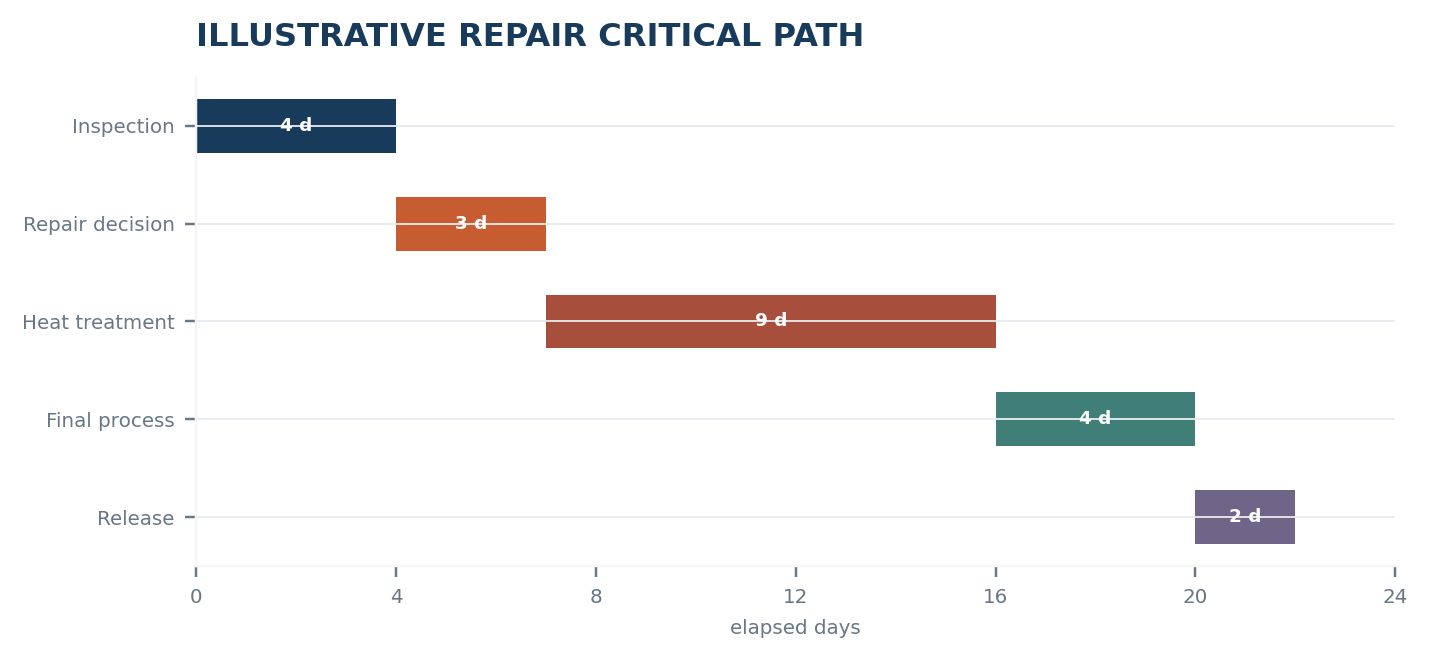
- Inspection outcomes determined which external path a part entered.
- Two repair paths converged on a limited heat-treatment capability.
- Replacement-casting exposure became material when repair yield moved below the planning assumption.
All values shown are illustrative and would be rebuilt from the agreed product scope and available evidence.
STRESS AND RESPONSE
Turnaround risk was tested as a path, not an average lead time
The analysis varied inspection yield, heat-treatment queue, repair approval and replacement-casting availability. This preserved the sequence of events and exposed when a small deterioration early in the path created a much larger release delay.
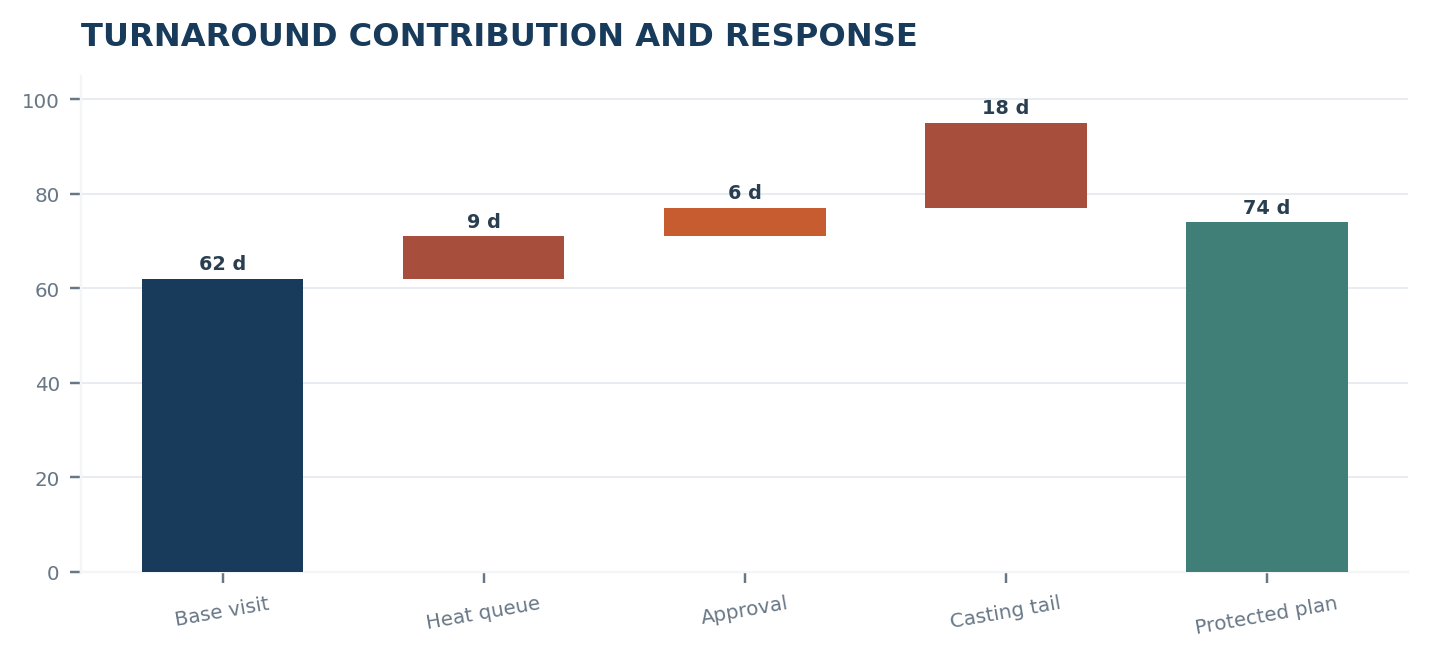
Response logic
Decision point | Action |
|---|---|
Slot protection | reserve external heat-treatment capacity by visit archetype |
Route diversification | qualify a second approved repair path for the exposed part family |
Tail protection | hold a targeted spare pool against the casting replacement path |
DECISION OUTCOME
What the analysis would support
ILLUSTRATIVE CONCLUSION Reserve heat-treatment slots for the highest-probability visit archetypes, qualify a second repair route for one part family and size a limited spare pool against the replacement-casting tail rather than the average shop visit.
What the client receives
shop-visit path library | approved capability map |
|---|---|
turnaround contribution model | repair-versus-replace triggers |
capacity reservation plan |
Delivery
Typical delivery: 8–11 weeks, depending on engine-family coverage and access to historical shop findings.
The final scope is set by the product, geography, tier depth, time horizon and decisions the study must support. Outputs can be supplied as an executive briefing, editable data model and monitoring specification.
Contact Us
DISCUSS YOUR SUPPLY CHAIN QUESTION Tell us which product, facility, sourcing decision or continuity concern you need to examine. August Research will define the dependency boundary, evidence plan and decision outputs around that question.