HOME APPLIANCES | MEXICO
Testing whether appliance supply can be localised without hidden concentration
A Localisation Readiness Ladder for a new manufacturing plant
CLIENT DECISION Can compressor and control-board supply be localised in Mexico without shifting dependence into imported sub-tier components?
Background
A home-appliance company planning a plant in Nuevo León wanted to increase regional content while protecting launch timing and product quality. A supplier's Mexican address was not sufficient evidence of localisation because key subassemblies, electronics and tooling could still come from outside the region.
14
COMPONENT FAMILIES
46
SUPPLIER ENTITIES
8
CANDIDATE LOCAL PLANTS
24
MONTHS TO TARGET RAMP
ILLUSTRATIVE ENGAGEMENT | The organisation, scope, figures, findings and conclusion below show how the service can be applied. They do not describe an actual client engagement.
RESEARCH DESIGN
Localisation Readiness Ladder
Each component family progressed through five gates: regional entity, local production, compatible capability, qualified output and resilient sub-tier supply. Local content was counted only at the highest gate supported by evidence and the client launch schedule.
01
Define local content
Set the geographic, transformation and value-add rules for the programme.
02
Resolve the footprint
Distinguish sales offices, warehouses, assembly sites and true production plants.
03
Test capability
Match process, tooling, specification, volume and quality-system requirements.
04
Trace sub-tier dependence
Identify imported electronics, motors, resins, metals and control components.
05
Sequence localisation
Prioritise component families by readiness, launch effect and concentration risk.
Evidence assembled
- trade, customs and shipment records
- supplier product and capability disclosures
- client specifications, volumes and launch gates
INDEPENDENT VALUE A common evidence structure reconciles internal records with external entity, facility, trade, capacity and event evidence. Assumptions that cannot be confirmed remain visible rather than being converted into false precision.
DEPENDENCY FINDING
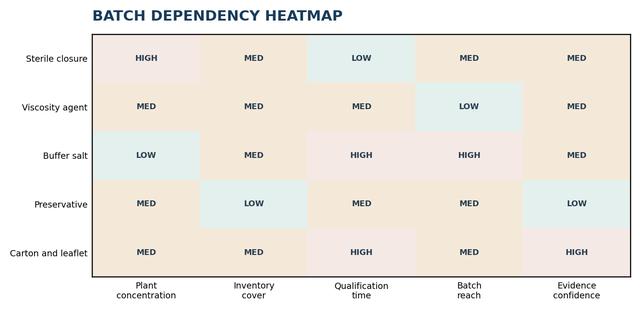
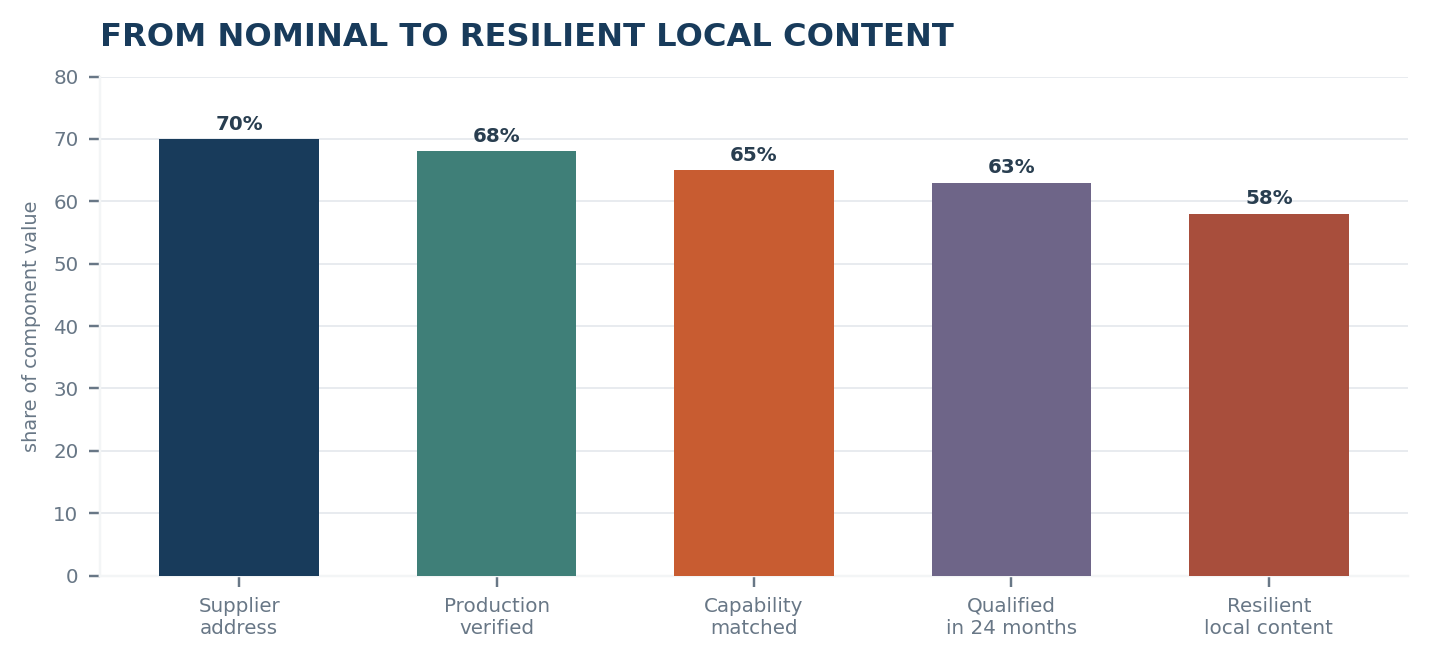
Nominal local content exceeded resilient local content
The supplier footprint suggested 70% local content was possible. After production capability, qualification timing and imported sub-tier dependencies were applied, 63% was feasible within 24 months. Control boards remained dependent on a concentrated imported electronics chain.
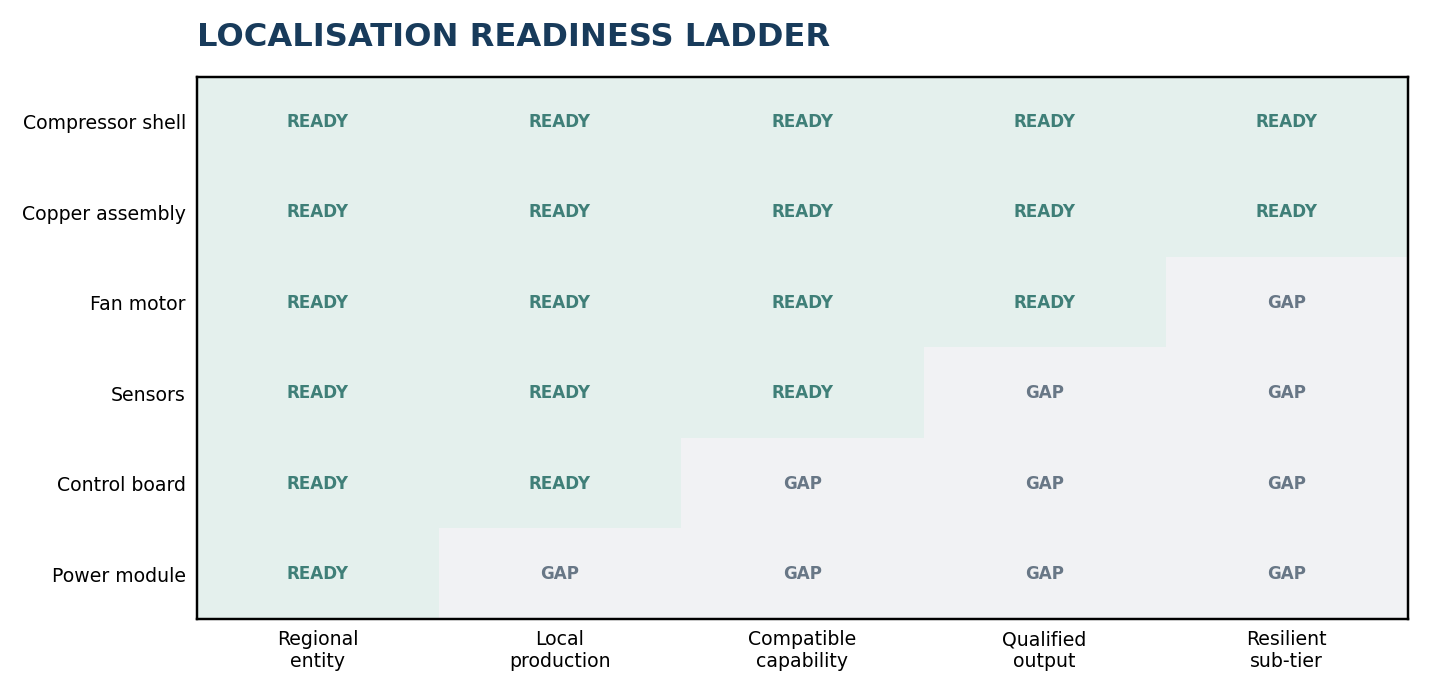
- A local legal entity did not prove local production or resilient sub-tier content.
- Mechanical component families advanced through the readiness gates faster than electronics.
- Control-board supply retained imported semiconductor and power-module concentration.
All values shown are illustrative and would be rebuilt from the agreed product scope and available evidence.
STRESS AND RESPONSE
Localisation choices were tested against launch and sub-tier failure
The model applied tooling delay, ramp-yield pressure, border interruption and a semiconductor allocation shock. This prevented the team from selecting suppliers that improved the local-content headline while increasing launch exposure.
Response logic
Decision point | Action |
|---|---|
Wave 1 | localise shells, copper assemblies and selected motors |
Launch protection | retain dual-region control-board supply through ramp |
Capability build | develop a Mexican electronics partner through staged qualification |
DECISION OUTCOME
What the analysis would support
ILLUSTRATIVE CONCLUSION Localise compressor shells, copper assemblies and selected motors first; retain dual-region control-board supply through launch; and develop one Mexican electronics partner against a staged qualification plan rather than an immediate volume commitment.
What the client receives
component localisation baseline | facility capability shortlist |
|---|---|
sub-tier dependency map | 24-month localisation roadmap |
local-content and resilience tracker |
Delivery
Typical delivery: 7–10 weeks, depending on bill-of-material depth and the number of candidate suppliers.
The final scope is set by the product, geography, tier depth, time horizon and decisions the study must support. Outputs can be supplied as an executive briefing, editable data model and monitoring specification.
Contact Us
DISCUSS YOUR SUPPLY CHAIN QUESTION Tell us which product, facility, sourcing decision or continuity concern you need to examine. August Research will define the dependency boundary, evidence plan and decision outputs around that question.