PHASE 2 | TECHNICAL DOCUMENTATION DEVELOPMENT & REVIEW | ENGAGEMENT 03
Developing an application note for a recombinant nuclease used in mRNA process development
How a biotechnology supplier could turn enzyme-characterisation, workflow evidence and intended-use limits into a credible technical application note.
THE DECISION
Can the team publish an application note that is technically useful to process-development scientists while keeping enzyme performance, workflow scope and intended-use language accurate?
CLIENT PROFILE
Hypothetical supplier of recombinant process-development enzymes
DOCUMENT SET
Application note, datasheet, product page, technical FAQ, distributor summary
PRODUCT CONTEXT
Recombinant nuclease for mRNA process-development workflows
DECISION HORIZON
Technical launch package for R&D and process-development users
RESEARCH EMPHASIS
Unit definition, reaction conditions, workflow evidence, intended use
AUDIENCES
Process scientists, assay developers, technical buyers, distributors
The situation
A biotechnology supplier is preparing literature for a recombinant nuclease proposed for reducing residual nucleic-acid carryover in selected mRNA process-development workflows. The product team has enzyme-characterisation data, small-scale workflow results and internal troubleshooting notes. Those sources are valuable, but they were generated for different questions. The application note needs to explain what the enzyme has been shown to do without converting an R&D-use workflow observation into a broad manufacturing, clinical or regulatory claim.
METHODOLOGY
How the technical evidence is made release-ready
The documentation review creates a narrow chain between the biochemical identity of the reagent, the defined reaction conditions, the evaluated workflow and the language offered to the reader. This protects technical utility without overstating transferability.
01 Define intended-use and reader boundary
Specify whether the document addresses research use, process development or another controlled audience, and identify language that must not suggest clinical or manufacturing suitability.
02 Standardise enzyme identity
Reconcile unit definition, activity assay, buffer composition, storage conditions, lot or release criteria and any supplier-controlled specification.
03 Map workflow evidence
Identify the exact step in the mRNA process-development workflow, substrate context, residence time, temperature, mixing conditions and downstream readout used in each study.
04 Review analytical interpretation
Check that claims about reduction, cleanup or performance reflect the measurement method, baseline, detection limit and relevant control conditions.
05 Build reader-specific copy
Develop a datasheet and application note that distinguish a product specification from an example workflow, limitation or troubleshooting suggestion.
DEFINE INTENDED-USE AND READER BOUNDARY
controlled source
MAP WORKFLOW EVIDENCE
condition check
BUILD READER-SPECIFIC COPY
release wording
The exact source set and technical fields are defined at project start. The process is designed to make document decisions traceable to evidence rather than to informal product memory.
EXAMPLE OUTPUT
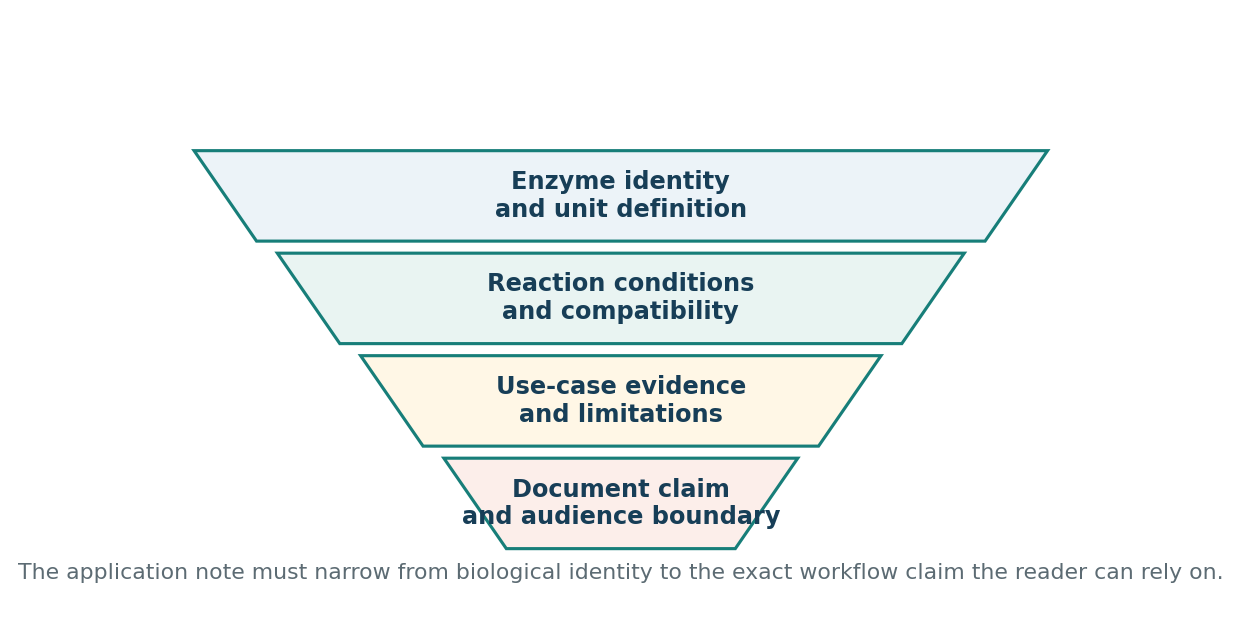
Application-note evidence funnel
The documentation should narrow as it moves from enzyme identity to workflow language. That makes the note more useful for scientists because the conditions they need are visible.
EVIDENCE THAT CAN BE STATED
Controlled information such as unit definition, storage, buffer recommendation and the stated scope of the product.
EVIDENCE THAT NEEDS CONTEXT
Workflow outcomes that depend on substrate, reaction conditions, assay method, process stage or the reader’s own optimisation work.
WEBSITE PRESENTATION SUGGESTION
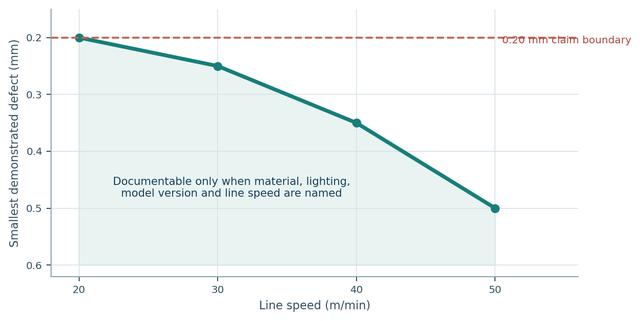
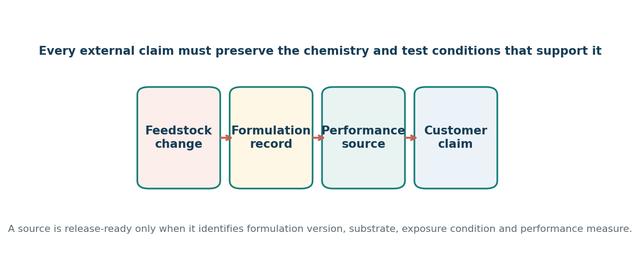
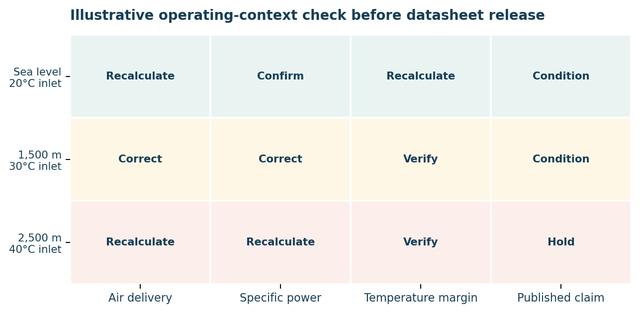
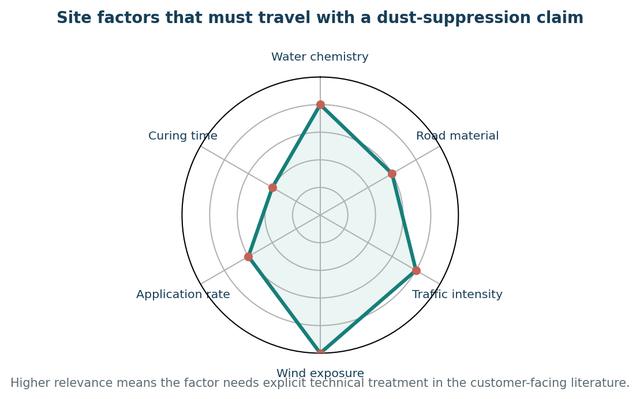
Use the graphic as an interactive evidence layer on the full engagement page. A reader can select a condition, workflow stage or site factor to see the exact document language it governs, rather than reading a generic process diagram.
DECISION AND HANDOVER
What the client receives
The work ends with an aligned document suite and a working evidence file. Both are designed for the people who must approve the language and the people who must use it in technical, commercial and customer-facing settings.
EVIDENCE WORKSHEET
Source-linked register for specifications, workflow figures, methods, limitations and intended-use wording.
TECHNICAL LITERATURE
Application note, data sheet and FAQ written for process-development users with explicit workflow boundaries.
REVIEW LOG
Approval record for scientific, quality and commercial owners plus open questions for future workflow studies.
Indicative delivery
A focused application-note review could take approximately 4 to 6 weeks, including source mapping, scientific review, content drafting and technical sign-off. Timing is illustrative and depends on source maturity, data ownership and the availability of scientific reviewers.
LET'S DISCUSS YOUR PROJECT
When technical literature has grown across reformulations, experiments, operating environments or customer requests, August Research can help establish the evidence boundary and prepare documentation that a technical team can stand behind.
Note: This engagement is hypothetical. The client profile, technical details, figures, timeline, findings and outputs are examples only and do not represent client outcomes. The final approach is shaped by the available evidence, product maturity and approval requirements.