PHASE 2 | TECHNICAL DOCUMENTATION DEVELOPMENT & REVIEW | ENGAGEMENT 01
Rebuilding the technical evidence behind an AI-enabled machine-vision inspection module
How a machine-vision developer could replace broad product claims with a brochure, application note and product-description suite built around a defined operating envelope.
THE DECISION
Can an updated inspection-system brochure and website suite be released now, and which claims must be verified, conditioned, rewritten or withheld?
CLIENT PROFILE
Hypothetical developer of industrial vision systems
DOCUMENT SET
Brochure, datasheet, website page, application note, distributor copy
PRODUCT BOUNDARY
16K line-scan camera, dual-angle light geometry, edge-AI inference
APPLICATIONS
Coated aluminium sheet, anodised profiles, precision-formed parts
DECISION HORIZON
Updated product literature before distributor enablement
RESEARCH EMPHASIS
Claim traceability, conditions of use and release-quality wording
WHAT THIS PAGE DEMONSTRATES
A documentation review can turn dispersed pilot evidence into a release-quality, traceable document suite. The focus is not on making the product sound broader. It is on making every technical statement accurate, usable and defensible.
THE SITUATION
A product narrative that has outpaced its evidence
A product team is preparing a refreshed market-facing suite for an AI-enabled module that continuously inspects moving metal surfaces. The product has been demonstrated on two pilot lines, but the existing brochure, website copy and distributor materials draw on different trials, software versions and lighting configurations. The documents present the module as broadly transferable across materials and line speeds, while the available evidence is narrower and condition-dependent.
The immediate risk: a technically capable product is described with claims that cannot be traced to a consistent configuration, test protocol or acceptance threshold. This creates a commercial problem for sales teams and an internal approval problem for engineering, quality and legal reviewers.
61
material claims reviewed
14
quantitative claims
3
model versions
92,000
annotated image segments
Illustrative working inventory. The counts are used to show how an evidence review can be structured; they do not represent a client project or observed outcome.
WHY THE QUESTION HAS BECOME URGENT
The documentation-to-performance problem
The issue is not whether the module can inspect a surface. It is whether each external statement identifies the technical boundary inside which the statement is meaningful. A line-scan camera specification, for example, may establish sensor and image-acquisition characteristics. It does not, by itself, demonstrate system-level detection performance for a named defect on a named substrate at a named production speed.
What the published suite currently implies
“Up to 99.5% inspection accuracy”; “detects defects as small as 0.2 mm”; “works across metals, plastics and coated materials”; “requires no model retraining”; “integrates with any existing quality-control system.”
What the evidence review needs to establish
The source, software version, material, illumination, defect class, line speed, performance metric, test method and integration conditions behind each statement.
Questions the work must resolve
1. Claim boundary: Which statements describe a hardware capability, which describe an AI-model result, and which are marketing shorthand for a qualified system performance?
2. Evidence maturity: Which source records can be controlled and reproduced, and which depend on informal pilot notes, demonstrations or undocumented parameter changes?
3. Operating envelope: Under what material, defect, lighting, model-version and line-speed conditions has the module actually been demonstrated?
4. Copy decision: What wording can be approved for the brochure, datasheet, website and distributor materials without converting a conditional result into a universal promise?
SCOPE BOUNDARY
Where an inspection module is positioned as a safety-related control function, the appropriate machinery and functional-safety obligations require a separate legal and conformity assessment. This engagement focuses on the technical accuracy and traceability of product documentation, not compliance certification.
METHODOLOGY
How the evidence behind the document is rebuilt
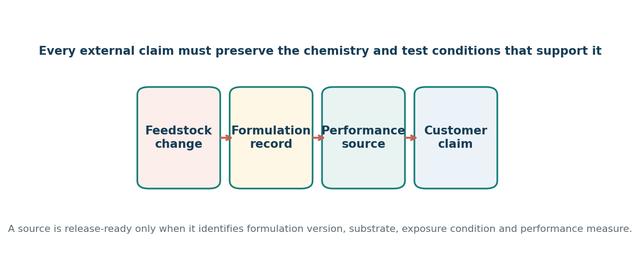
The review follows a claim-led evidence chain. Each statement is treated as a technical proposition that must be linked to a configuration, source record and decision on permitted wording. The process deliberately separates camera-characterisation evidence from the end-to-end performance of the inspection system and its AI model.
01 Scope and configuration lock
Define the sellable configuration: camera resolution, lensing, illumination geometry, encoder synchronisation, inference hardware, model version, software release and integration interfaces. Exclude variants that are not part of the release decision.
02 Controlled source inventory
Collect the current document suite, pilot reports, validation protocols, annotated image sets, defect taxonomy, change logs, model-training records, test videos, supplier specifications and integration notes. Date-control every source and identify its owner.
03 Claim extraction and taxonomy
Extract every material statement. Classify it as hardware specification, system capability, quantitative performance, interoperability, material applicability, workflow impact or future-facing claim. Map the claim to every document where it appears.
04 Conditions reconstruction
For each quantitative or broad capability statement, reconstruct the tested material, surface finish, defect class, defect contrast, illumination, line speed, sampling regime, confidence threshold and failure definition.
05 Cross-check and wording design
Compare the claim against the strongest traceable source. Mark it verified, conditional, unresolved or contradicted. Draft the document-specific wording, qualification, footnote or hold instruction needed for release.
DOCUMENTATION CONTROL
Claim-review fields
The claim register gives technical owners a common decision frame before content is rewritten. It makes a clear distinction between a specification that can be stated directly, a result that must remain conditional and a statement that should not be released yet.
Claim or figure | Minimum source record | Conditions that must travel with it | Release decision |
|---|---|---|---|
Detection limit | Test report, image sample, model log | Material, defect class, line speed, lighting, confidence threshold | State condition or hold |
Accuracy statement | Confusion matrix and pass/fail definition | Class distribution, false-positive treatment, model version | Replace broad accuracy wording |
Integration statement | Interface specification and completed integration record | Protocol, PLC/MES environment, site-specific work | Use conditional integration language |
EDITORIAL DECISION LOGIC A strong source record does not automatically justify broad copy. The proposed wording must preserve the operating conditions and the distinction between a component specification, a demonstrated system result and an untested application claim. | |||
EXAMPLE OUTPUT
Performance envelope blueprint
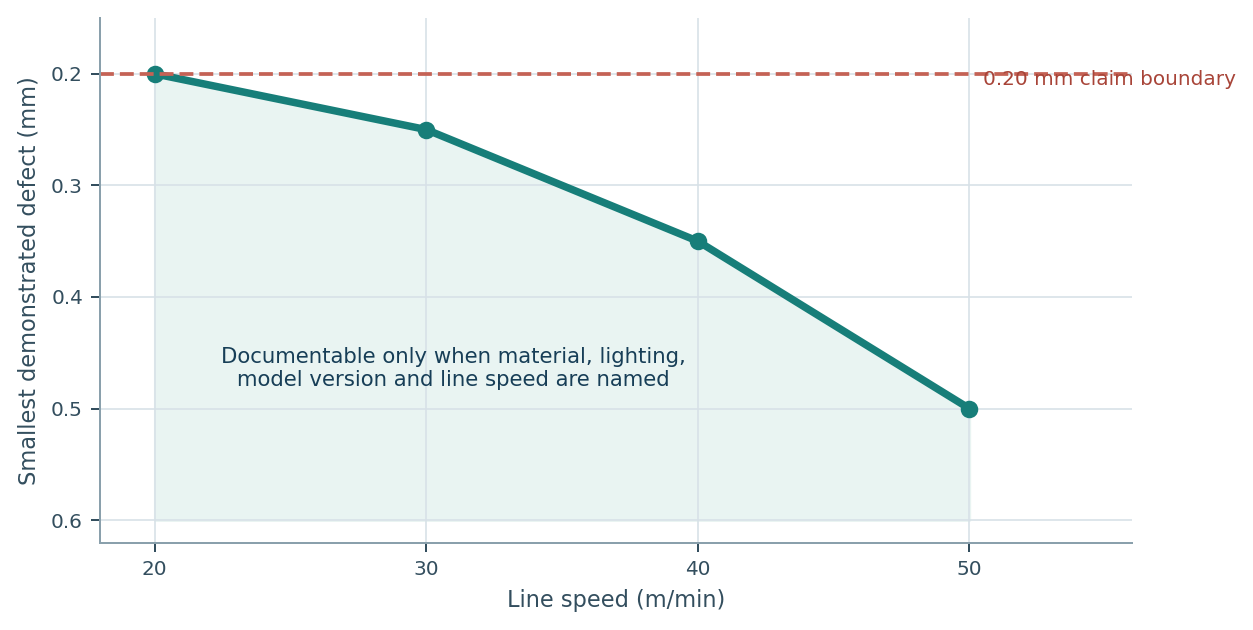
Instead of treating “0.2 mm detection” as a portable product claim, the working output can show the set of operating conditions where a result has been demonstrated. This gives product marketing a practical content boundary and gives engineering a focused list of evidence gaps to close.
WEBSITE PRESENTATION SUGGESTION
Use the performance envelope as a scroll-activated canvas on the full engagement page: product conditions sit on the axes, and each approved claim appears only inside its evidence-supported zone. Avoid using the chart as a product performance promise.
EVIDENCE INTERPRETATION
What the working output might reveal
The same document suite can contain different evidence statuses. The handover should make those statuses visible so each approving function can decide what it is prepared to publish, condition or test next.
The hardware resolution, line-scan architecture and selected industrial interfaces can be documented as configuration specifications, where supported by controlled supplier or engineering records.
A 0.20 mm defect result may be used only with the relevant coated-aluminium condition, illumination geometry, model version and maximum demonstrated line-speed range.
“No model retraining” may not survive review if change logs show recalibration or re-annotation after material, defect-class or illumination changes.
Claims extending performance to plastics or all existing quality-control systems should be held until the product boundary and evidence are expanded.
How the language would change
CURRENT DRAFTING RISK
RELEASE-QUALITY DIRECTION
“Detects defects as small as 0.2 mm at line speed.”
“Demonstrated detection of selected 0.20 mm defect classes on coated aluminium under the documented lighting, model version and operating-speed conditions.”
DECISION AND HANDOVER
Recommended documentation decision
Release the updated literature as a controlled suite rather than a direct refresh of existing copy. Publish traceable configuration specifications. Frame AI and inspection-performance statements within the demonstrated operating envelope. Withhold untested material and integration claims until there is a defined validation plan and controlled source record.
TECHNICAL WORKING FILE
RELEASE-READY DOCUMENT SUITE
HANDOVER AND NEXT ACTIONS
Claim register with source links, configuration fields, evidence status and comments for technical owners.
Rewritten brochure, datasheet, website copy, distributor language and application-note outline, each matched to its approval boundary.
Evidence-gap list, claim-approval protocol and scoped validation questions for materials, line speeds, defect classes and integration environments.
Indicative delivery
A focused review of an established document suite could be completed in approximately 5 to 7 weeks: one week for scope and source control, two to three weeks for claim reconstruction and technical review, then one to two weeks for drafting, stakeholder resolution and handover. Timing is illustrative and depends on source availability, access to technical owners and the maturity of existing validation records.
Questions reserved for client validation
Which materials, defect classes and line-speed ranges does the team intend to market in the next 12 to 18 months?
Who can approve system performance, model-change history, integration claims and any customer-referenced statement?
Which claim categories require a controlled test report, and which can be described as a product architecture or workflow capability?
NEXT STEP
Preparing a project discussion
A useful initial discussion begins with the commercial decision, the product configuration in scope and the documents that need to be released. It does not require a complete evidence package, but it does benefit from knowing where sources, owners and approval thresholds currently sit.
Useful starting materials
CURRENT DOCUMENTS
Brochure, datasheet, website page, application note, distributor copy and any controlled product description.
TECHNICAL RECORDS
Test reports, pilot outputs, model and software histories, integration notes, defect taxonomy and source owners.
COMMERCIAL PRIORITIES
The application, material, defect classes and operating conditions the team needs to describe in the next release.
APPROVAL PATH
Named technical, quality, product and commercial reviewers, plus the decision rule for claims that remain conditional.
LET'S DISCUSS YOUR PROJECT
If your product documentation has grown across pilots, design iterations and sales materials, August Research can help establish what the evidence supports, where the product boundary sits and how the final language should be released.
Note: This engagement is hypothetical. The client profile, product details, counts, timeline, findings and outputs are illustrative and are not actual client outcomes. The final approach is tailored to the available evidence, product maturity and approval requirements.