PHASE 2 | TECHNICAL DOCUMENTATION DEVELOPMENT & REVIEW | ENGAGEMENT 02
Rebuilding a corrosion-inhibitor documentation suite after a feedstock reformulation
How a specialty-chemicals supplier could reconnect performance claims, compatibility language and product literature after a raw-material change.
THE DECISION
Which existing technical claims can remain in market-facing literature, which need a formulation-specific qualification, and which require new evidence before release?
CLIENT PROFILE
Hypothetical supplier of waterborne corrosion inhibitors
DOCUMENT SET
TDS, application guide, website page, distributor sheet, product brochure
PRODUCT CONTEXT
Reformulated inhibitor used on fabricated steel components
DECISION HORIZON
Release of updated technical literature before regional launch
RESEARCH EMPHASIS
Formulation lineage, test conditions, claim permissions
AUDIENCES
Technical sales, coatings formulators, distributors, procurement teams
The situation
A supplier has replaced a key feedstock to improve availability and meet updated customer requirements. The reformulated product has retained its commercial identity, but the existing technical data sheet cites older salt-spray, humidity and compatibility results without making the formulation version visible. The commercial team needs updated material that explains the product clearly without implying that every historic result transfers unchanged.
METHODOLOGY
How the technical evidence is made release-ready
The review starts by treating the formulation as part of the claim boundary. A corrosion result only becomes usable documentation when the formulation version, substrate preparation, exposure method, coating system and performance measure can be traced together.
01 Lock the formulation identity
Define the release version, raw-material change, concentration range, additive package and manufacturing route represented by the new documentation.
02 Control the source set
Collect formulation records, batch specifications, historical and current test reports, coating-system compatibility notes, customer technical queries and current literature.
03 Separate chemistry from performance
Distinguish statements about composition, handling or recommended use from claims about corrosion protection, film formation, compatibility or durability.
04 Reconstruct test conditions
Capture substrate, pretreatment, coating stack, test method, exposure duration, concentration, pH and evaluation criteria behind each performance statement.
05 Draft claim-controlled documents
Rewrite each document for its reader, retaining formulation-specific conditions and flagging any comparison that needs technical or regulatory review.
LOCK THE FORMULATION IDENTITY
controlled source
SEPARATE CHEMISTRY FROM PERFORMANCE
condition check
DRAFT CLAIM-CONTROLLED DOCUMENTS
release wording
The exact source set and technical fields are defined at project start. The process is designed to make document decisions traceable to evidence rather than to informal product memory.
EXAMPLE OUTPUT
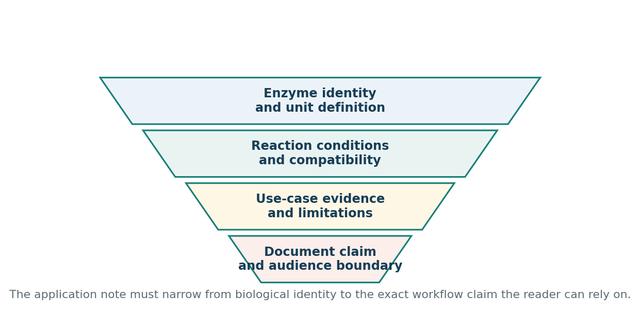
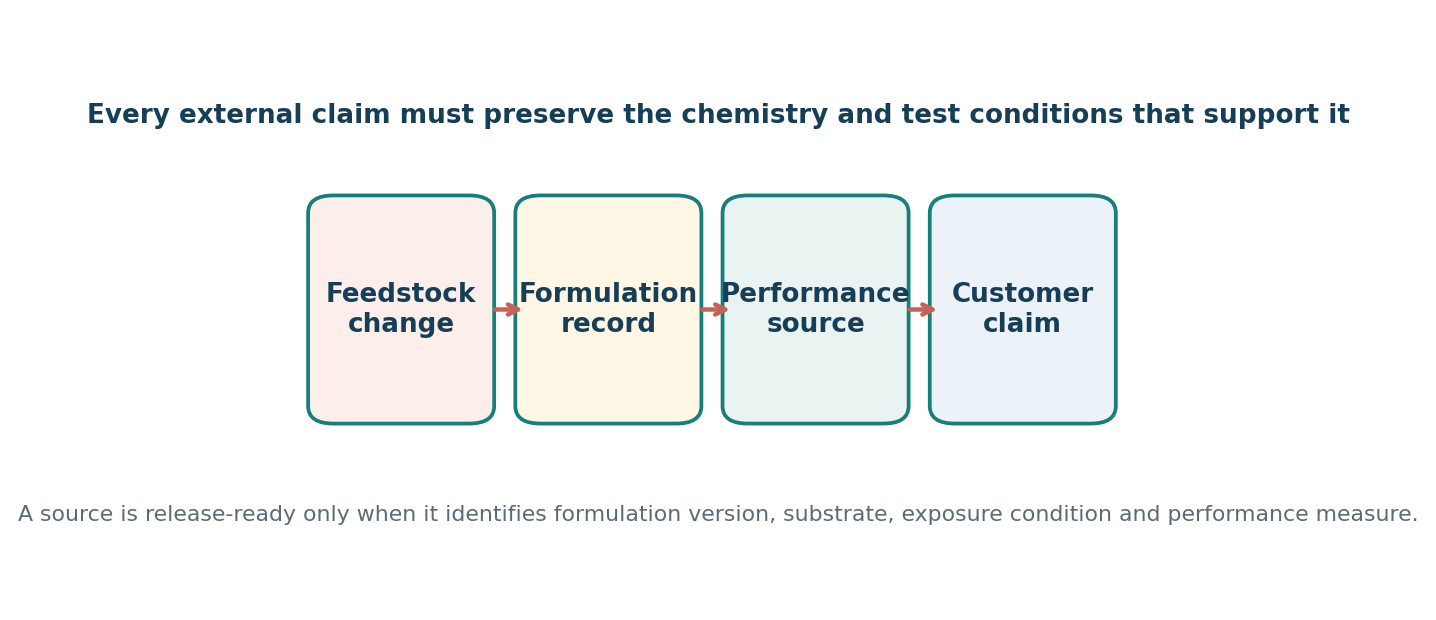
Claim provenance ladder
The output gives the technical and commercial teams one visible path from a formulation change to the customer statement that can be released.
WHAT MAY REMAIN
Handling guidance and composition-neutral use instructions supported by current formulation records.
WHAT MUST CHANGE
Corrosion-protection and compatibility language that currently relies on a superseded formulation or incomplete test context.
WEBSITE PRESENTATION SUGGESTION
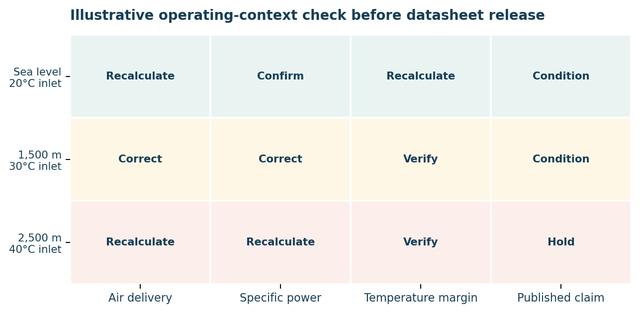
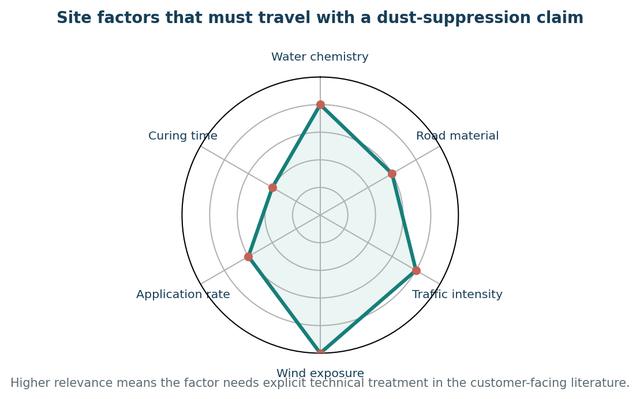
Use the graphic as an interactive evidence layer on the full engagement page. A reader can select a condition, workflow stage or site factor to see the exact document language it governs, rather than reading a generic process diagram.
DECISION AND HANDOVER
What the client receives
The work ends with an aligned document suite and a working evidence file. Both are designed for the people who must approve the language and the people who must use it in technical, commercial and customer-facing settings.
EVIDENCE REGISTER
Formulation-to-claim register with source, test condition and approval status.
RELEASE DOCUMENTS
Updated TDS, product page and application guidance with controlled wording.
GAP PLAN
Targeted test or source requests where a current commercial claim lacks a release-ready record.
Indicative delivery
A focused review could take approximately 4 to 6 weeks: source control and formulation mapping in week one, technical reconstruction in weeks two to three, then drafting, review and handover. Timing is illustrative and depends on access to formulation and test records.
LET'S DISCUSS YOUR PROJECT
When technical literature has grown across reformulations, experiments, operating environments or customer requests, August Research can help establish the evidence boundary and prepare documentation that a technical team can stand behind.
Note: This engagement is hypothetical. The client profile, technical details, figures, timeline, findings and outputs are examples only and do not represent client outcomes. The final approach is shaped by the available evidence, product maturity and approval requirements.