PHASE 2 | TECHNICAL DOCUMENTATION DEVELOPMENT & REVIEW | ENGAGEMENT 04
Reconciling an oil-free centrifugal compressor datasheet across operating environments
How a commercial-equipment manufacturer could make capacity, efficiency and operating-limit language useful across real site conditions.
THE DECISION
Which datasheet figures can be presented as reference-condition specifications, and how should the documents direct a buyer to site-specific evaluation when ambient conditions change?
CLIENT PROFILE
Hypothetical manufacturer of oil-free centrifugal compressors
DOCUMENT SET
Datasheet, selection guide, product page, tender response library, distributor sheet
PRODUCT CONTEXT
Compressed-air equipment offered across hot, high-altitude and variable-load sites
DECISION HORIZON
Regional sales enablement and a revised datasheet release
RESEARCH EMPHASIS
Reference conditions, selection assumptions, environmental corrections
AUDIENCES
Plant engineers, EPC teams, distributors, procurement and service groups
The situation
A commercial-equipment team has one core datasheet that is used in industrial sales conversations spanning sea-level process plants, elevated sites and hot-climate installations. The document lists capacity, specific-power and discharge-temperature values, but the boundary between a reference-condition figure and a site-specific selection result has become blurred. Sales teams need a technically clear way to discuss expected performance without presenting corrected values as universal equipment capability.
METHODOLOGY
How the technical evidence is made release-ready
The review separates stable product architecture from performance values that depend on inlet conditions, altitude, pressure ratio, turndown, cooling arrangement and control strategy. The documentation is then rebuilt around a transparent reference basis and a disciplined path to site-specific selection.
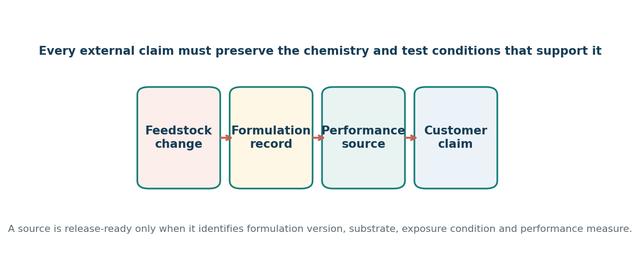
01 Define the reference basis
Identify the reference conditions used for declared air delivery, power, pressure, temperature and control range, including units and measurement conventions.
02 Map environmental dependencies
Collect selection tools, test records, field notes and engineering assumptions that show how inlet temperature, altitude, humidity and cooling conditions affect a stated value.
03 Separate guaranteed, nominal and indicative values
Classify each number according to its document role and the evidence available for the target configuration.
04 Rebuild the selection path
Create the wording and information request that guides sales teams and buyers from a generic datasheet to a documented site-specific evaluation.
05 Align tender and product documents
Check that datasheet statements, tender libraries, product pages and distributor materials use the same condition language and do not conflict.
DEFINE THE REFERENCE BASIS
controlled source
SEPARATE GUARANTEED, NOMINAL AND INDICATIVE VALUES
condition check
ALIGN TENDER AND PRODUCT DOCUMENTS
release wording
The exact source set and technical fields are defined at project start. The process is designed to make document decisions traceable to evidence rather than to informal product memory.
EXAMPLE OUTPUT
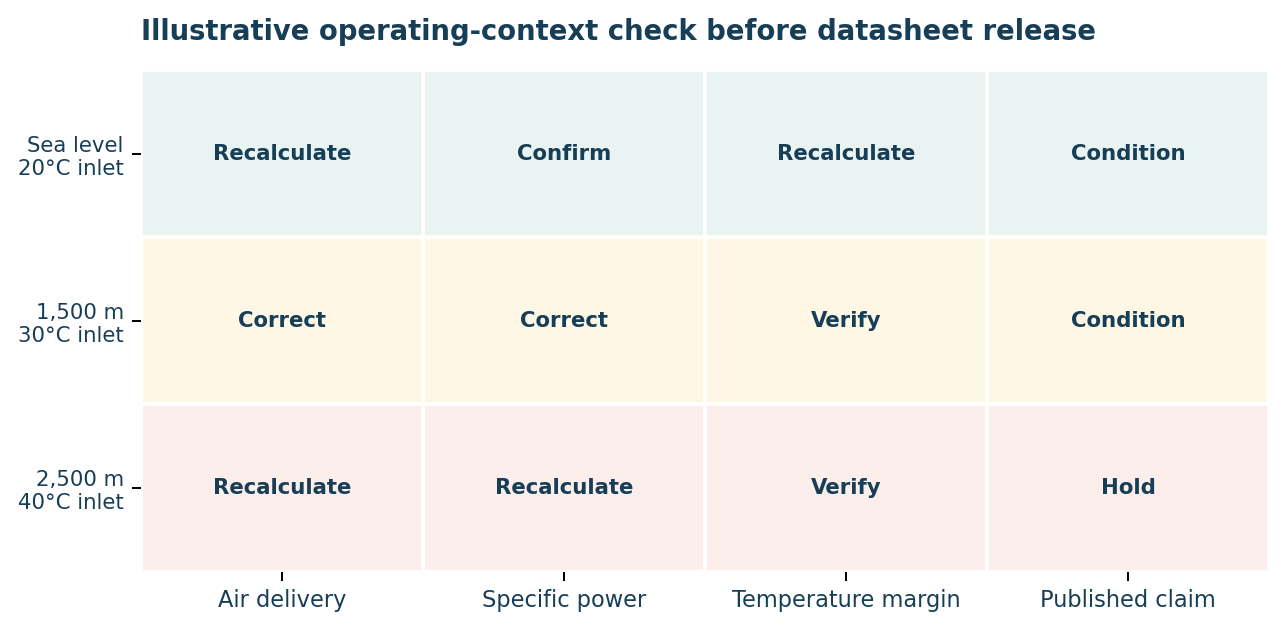
Operating-context check
The check highlights that the question is not simply whether a compressor can operate at a site. It is whether a published number remains meaningful in that site context.
REFERENCE-CONDITION STATEMENT
A clearly labelled product figure with the defined conditions and intended comparison use.
SITE-SPECIFIC DIRECTION
A documented request for inlet, ambient, altitude, pressure and control information before a selection or commitment is issued.
WEBSITE PRESENTATION SUGGESTION
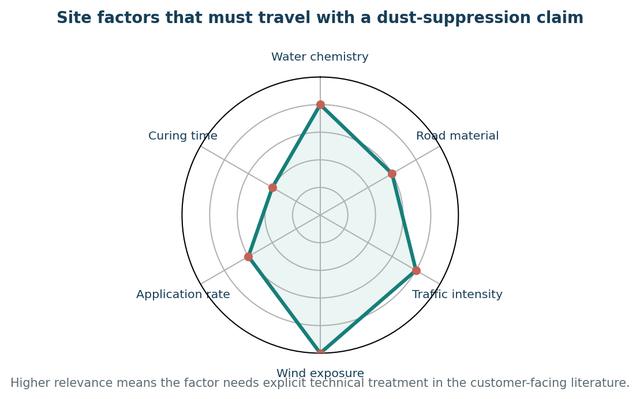
Use the graphic as an interactive evidence layer on the full engagement page. A reader can select a condition, workflow stage or site factor to see the exact document language it governs, rather than reading a generic process diagram.
DECISION AND HANDOVER
What the client receives
The work ends with an aligned document suite and a working evidence file. Both are designed for the people who must approve the language and the people who must use it in technical, commercial and customer-facing settings.
DATASHEET ARCHITECTURE
Reference-condition, nominal-value and site-evaluation language matched to the product configuration.
COMMERCIAL TOOLKIT
Selection-question sheet and tender-response guidance for technical sales and distributor teams.
DOCUMENT CONTROL LOG
Conflicting figures, required corrections and decision ownership across product, engineering and commercial functions.
Indicative delivery
A datasheet and document-suite review could take approximately 5 to 7 weeks: source collection and reference-condition audit, performance-language reconstruction, then drafting and stakeholder review. Timing is illustrative and depends on the availability of selection tools and engineering records.
LET'S DISCUSS YOUR PROJECT
When technical literature has grown across reformulations, experiments, operating environments or customer requests, August Research can help establish the evidence boundary and prepare documentation that a technical team can stand behind.
Note: This engagement is hypothetical. The client profile, technical details, figures, timeline, findings and outputs are examples only and do not represent client outcomes. The final approach is shaped by the available evidence, product maturity and approval requirements.