TECHNICAL EXPERT PANELS | ILLUSTRATIVE ENGAGEMENT
Architecture choice for an industrial wastewater-recovery system
A structured panel to select the configuration that best balances recovery, uptime, energy demand, operator burden and permitting.
The Decision
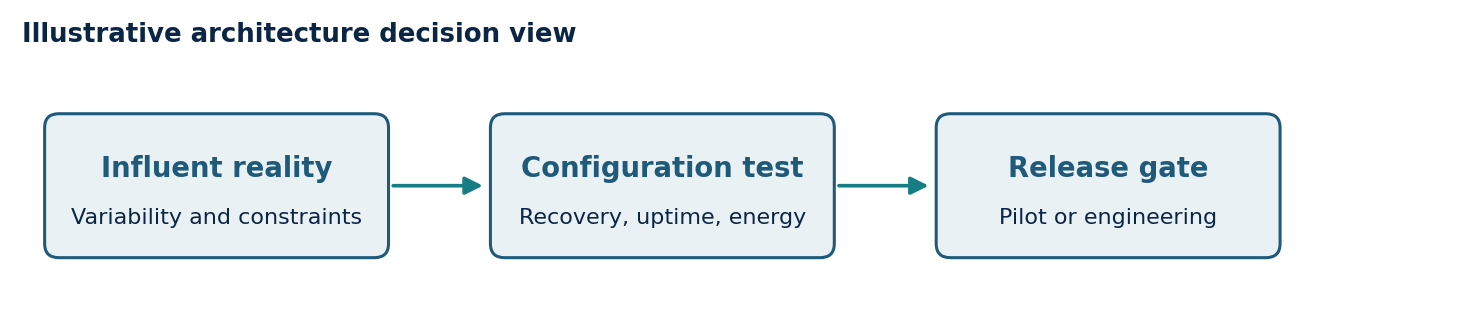
A fictional advanced-manufacturing facility faces rising water constraints and an increasingly costly wastewater profile. It has shortlisted three treatment configurations to recover water for non-potable plant use. Before commissioning a pilot or issuing an engineering package, leadership must choose which architecture has a defensible operating case.
Illustrative Client Context
The facility has variable wastewater streams from cleaning, rinse and process-support operations. It has historical sampling, a target reuse demand and a constrained utility footprint. The unresolved issue is not whether recovery is attractive in principle, but which configuration can perform reliably as influent conditions, maintenance realities and discharge requirements change.
Why This Requires a Technical Expert Panel
Recovery percentage alone is not the right decision metric. An architecture may look attractive on nominal water balance yet fail on fouling, chemical demand, concentrate handling, operator workload, resilience or permit conditions. The panel is designed to test the interfaces among process chemistry, equipment reliability, reuse quality, utility economics and compliance.
Panel Architecture
The panel brings treatment-process, plant-operations, utilities, automation, environmental permitting and maintenance perspectives into one architecture review. Its task is to identify the configuration and operating envelope that can survive real plant conditions.
Treatment-process design
Challenges removal mechanisms, fouling risk and concentrate management.
Plant operations and maintenance
Tests operator burden, clean-in-place requirements, spares and failure recovery.
Utilities and economics
Compares energy, chemical and water-balance implications across realistic load cases.
Environmental compliance
Assesses discharge, reuse and monitoring implications before design commitment.
Evidence Base for Discussion
The panel works from a clear separation between client evidence, external context and open questions. It is not asked to validate a marketing claim or replace the client’s own technical and regulatory accountability.
Client evidence
Historical wastewater quality and flow data; target reuse specification; layout constraints; shortlisted process concepts; utility tariff and operating assumptions.
External context
Industrial water-reuse guidance; discharge and pretreatment context; vendor performance boundaries; relevant monitoring and reliability practices.
Open questions
Influent excursions; scaling and fouling; peak reuse demand; brine or residuals route; operator staffing; online monitoring; permit amendment needs.
What the Panel Must Resolve
Architecture selection
Which configuration is preferred for the defined influent range and reuse target?
Resilience envelope
How does each option perform under peak contaminants, upset conditions and equipment downtime?
Quality assurance
Which online and offline controls are required before recovered water reaches its intended use?
Residuals route
Are concentrate, sludge or reject-stream implications viable in the actual site setting?
Pilot boundary
What must be demonstrated in a pilot, and what cannot be assumed from vendor data?
Decision gate
What energy, uptime, quality and compliance thresholds should release engineering or stop the route?
Client-Ready Outputs
Architecture Decision Record
Compares the shortlisted options against the plant conditions that can change the outcome.
Operating-Envelope Map
Defines influent, reuse, maintenance and monitoring conditions under which the preferred route is credible.
Pilot Evidence Plan
Sets test cases, sampling, reliability checks and release criteria for the next validation step.
Permitting and Residuals Brief
Highlights the approvals, discharge interfaces and waste-handling questions that need early resolution.
August Research Perspective
This engagement is not a technology vendor scorecard. It creates a defensible operating choice by challenging how each architecture behaves when the water chemistry and the plant do not follow the design case.
Research Sources for this Illustrative Engagement
The sources below inform the technical context and engagement design. They are not presented as client findings.
U.S. Environmental Protection Agency, Navigating the NPDES Permitting Process for Water Reuse Projects, 2022.
U.S. Environmental Protection Agency, 2012 Guidelines for Water Reuse.
U.S. Environmental Protection Agency, Industrial User Permitting Guidance Manual, current guidance.
Let’s Discuss Your Project
If your next technical commitment depends on competing specialist judgements, August Research can design a Technical Expert Panel around the evidence, interfaces and decision gates that matter most.