TECHNICAL EXPERT PANELS | ILLUSTRATIVE ENGAGEMENT
Qualification route for a high-voltage battery thermal-management material
A structured panel to decide whether a proposed thermal interface material should enter vehicle-level validation.
Illustrative engagement. Not a client case study.
The Decision
A fictional battery-material supplier has developed a conformable thermal interface material for high-voltage EV battery packs. Early testing indicates promising heat-transfer and gap-filling performance. Before committing to a vehicle-level validation programme, the supplier and a prospective battery-system partner must decide whether the material has a credible qualification route, or whether critical uncertainties should be resolved first.
Panel decision question
Should the material advance to vehicle-level validation now, advance only through a targeted pre-validation plan, or be redirected before further investment?
Why This Cannot Be Decided by Thermal Conductivity Alone
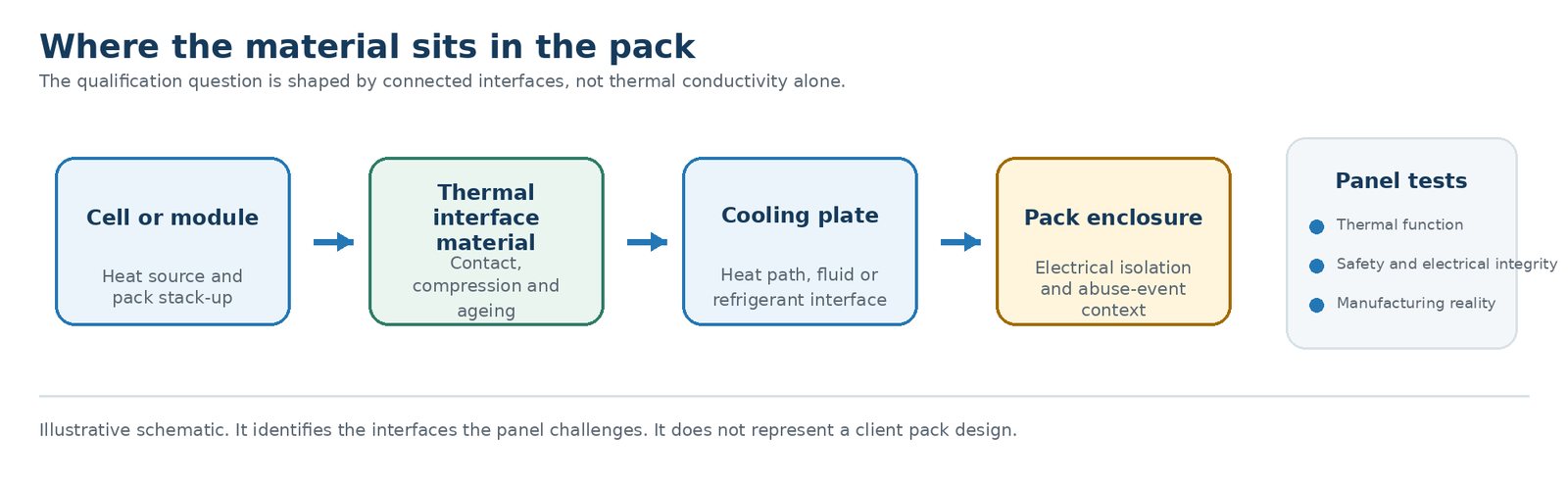
At pack level, the material sits inside a connected system. Its value depends on the contact it maintains across tolerances and cycling, the way it is dispensed and cured, the electrical and safety requirements around it, the service and repair implications it creates, and the supplier controls needed to reproduce it at volume. A strong bench result does not resolve those interfaces.
Thermal function
Heat transfer, contact stability and performance through duty cycles.
Safety and electrical integrity
Interaction with high-voltage insulation, flammability and abuse-event design.
Manufacturing reality
Dispensing, cure window, rework, yield, handling and line compatibility.
Illustrative Client Context
The illustrative material is intended for use between cells or modules and a cooling plate in a next-generation passenger EV pack. The client has a working formulation, application data from laboratory samples and an initial target application. What is unresolved is the route from promising material data to a manufacturable, safe and controllable pack-level component.
Known at the start | Still uncertain | Decision consequence |
|---|---|---|
The material has been tested on representative coupons under controlled conditions. | Whether contact, pump-out resistance and thermal behaviour remain acceptable across pack tolerances, vibration and ageing. | A pass on coupons may not justify an integrated validation commitment. |
A potential battery-system partner is interested in the application. | Whether dispensing, cure and inspection can be integrated without introducing cycle-time, yield or rework risk. | The preferred material may be impractical on the intended production route. |
The client has safety and electrical requirements to satisfy. | How the material affects insulation, fire and abuse-event design within the proposed pack architecture. | Safety evidence may change the test sequence or disqualify an application. |
A supply path exists for key ingredients. | Whether raw-material variation, batch release, packaging and handling controls can preserve application performance. | Supplier control requirements may need to be defined before nomination. |
Panel Architecture
This engagement uses a purpose-built panel, not a generic battery roundtable. The panel is selected to challenge the interfaces that decide qualification, with each participant receiving the same neutral evidence pack and submitting an independent assessment before discussion.
Perspective | What it tests in the decision |
|---|---|
Battery thermal systems engineer | Whether the material addresses the actual thermal problem and remains effective within the cooling and pack architecture. |
Cell or module integration engineer | Mechanical stack-up, compression behaviour, assembly interfaces and the consequences for pack design. |
High-voltage safety and materials specialist | Electrical insulation, flammability, outgassing, compatibility and safety-relevant evidence needs. |
Battery-pack manufacturing engineer | Dispensing, cure, takt time, inspection, rework, material handling and likely yield risks. |
Quality and supplier-development lead | Material specification, lot control, change management, incoming quality and validation ownership. |
Serviceability or lifecycle specialist | Repair, disassembly and end-of-life implications where the material becomes part of the pack interface. |
How the Panel Works
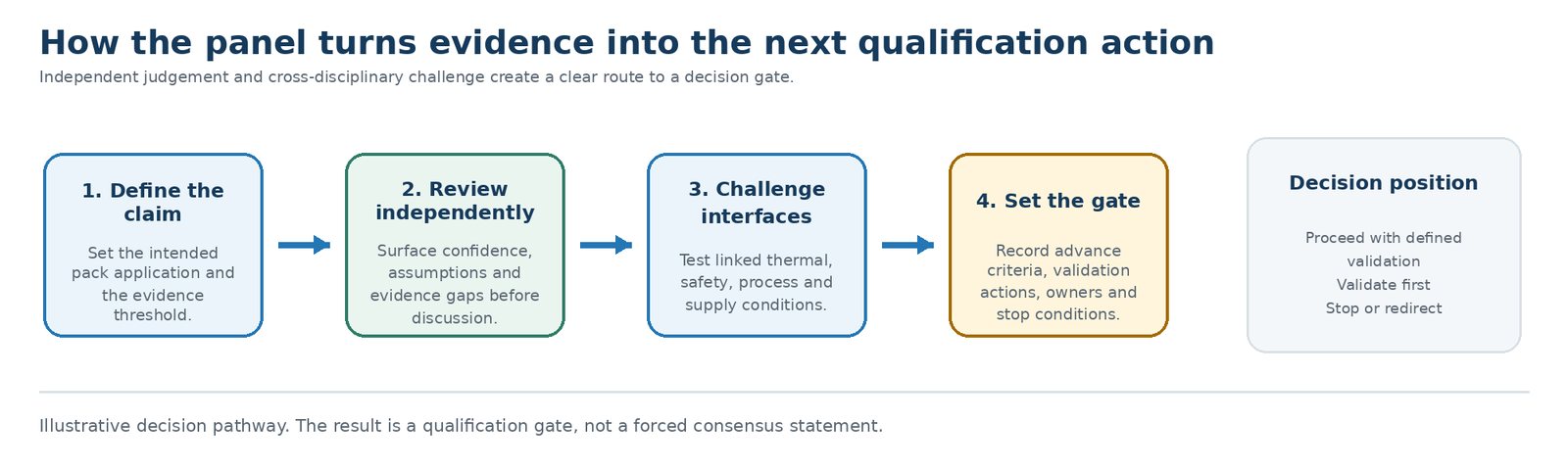
The engagement is deliberately structured to expose the conditions beneath a recommendation. It does not seek forced consensus and does not substitute for the client’s engineering, safety or regulatory accountability.
Panel stage | Illustrative activity | What the client receives |
|---|---|---|
1. Set the advance threshold | Define the target application, the decision owner, the baseline alternative and the minimum evidence required to enter vehicle-level validation. | A clear advance, hold or redirect question. |
2. Map the qualification claims | Separate claims about thermal function, interface behaviour, safety, processability and supply control. Identify the dependencies that could change each claim. | A claim and dependency map. |
3. Review evidence independently | Panelists review a neutral pack containing client-provided data, relevant public context and clearly labelled open questions. | Private assessments with confidence levels and reasons. |
4. Challenge critical interfaces | Facilitated deliberation tests the interactions among material, pack design, process window, safety case and supplier controls. | Agreement, qualified agreement and contention recorded distinctly. |
5. Release the next action | Translate the resulting position into a staged evidence plan with owners, pass criteria and stop conditions. | A Technical Decision Record and validation-gate roadmap. |
Illustrative Evidence Pack
The panel is not asked to validate a marketing claim. It is asked to test a specific decision against a transparent evidence base. The following materials would be separated by status: client evidence, external context and open questions.
- Client evidence: formulation and material specification; coupon-level thermal, mechanical and electrical results; preliminary application data; proposed pack location; draft process route; supplier and batch-control information.
- External context: relevant battery-pack materials guidance, test-method context, safety expectations and manufacturing considerations that shape the questions, not the client outcome.
- Open questions: pack compression profile; thermal cycling and vibration conditions; electrical isolation requirements; abuse-event exposure; production process limits; inspection plan; rework feasibility; change-control rules.
What the Panel Must Resolve
Decision domain | Question the panel tests | Illustrative gate |
|---|---|---|
Application fit | Does the material solve a defined pack-level thermal need better than the baseline under relevant operating conditions? | Advance only if the target thermal function and interface stability are specified for the intended location. |
Safety and electrical integrity | Are the evidence gaps around electrical isolation, flammability and abuse-event behaviour understood and sequenced appropriately? | Hold vehicle-level validation until safety-critical evidence has an agreed owner, method and acceptance basis. |
Manufacturing integration | Can the material be dispensed, cured, inspected and reworked inside the proposed production envelope? | Redirect if the process requires unrealistic cycle time, uncontrolled handling or creates unacceptable rework risk. |
Supply and quality control | Can the supplier control the attributes that drive application performance across lots and changes? | Advance only with a draft control plan, material-release logic and change-notification requirements. |
Validation strategy | Which tests must precede vehicle-level work, and what result would trigger a stop or redesign? | Release the next stage only when a test sequence links each critical claim to a decision criterion. |
Illustrative Decision Position
Example outcome: conditional advance
The panel could recommend a targeted pre-validation phase rather than immediate vehicle-level validation. This would protect the client from committing to a costly programme before pack-interface stability, process capability and safety-critical evidence are sufficiently defined. The outcome is illustrative, not a finding about any material or company.
Proceed
Confirm the target application and define a small number of testable qualification claims.
Validate first
Run the agreed interface, process-window and safety evidence plan before a vehicle-level programme.
Stop or redirect
Pause the route if critical safety, manufacturability or supply-control conditions cannot be met.
Client-Ready Outputs
Output | Role in the qualification decision |
|---|---|
Battery Material Technical Decision Record | States the panel position, confidence level, evidence basis, material caveats and recommended next action. |
Pack-Interface Claim Map | Shows where thermal, mechanical, electrical, process and supply claims are linked, and where a failure in one area can change the route. |
Qualification Gate Plan | Sets the tests, methods, owners, decision criteria and stop conditions required before vehicle-level validation. |
Manufacturing and Supplier Control Brief | Captures process-window assumptions, quality controls, lot-release needs and change-management requirements. |
Agreement and Contention Register | Separates what the panel supports from what remains conditional or unresolved, with the reason for each position. |
August Research Perspective
This engagement is not a broad review of battery thermal-management materials. It is a controlled decision forum for the qualification route of one proposed material in one intended pack context. By bringing thermal, integration, safety, manufacturing, quality and lifecycle perspectives into the same evidence-led discussion, August Research helps clients identify what must be true before they commit to vehicle-level validation.
Research Sources for this Illustrative Engagement
The sources below inform the technical context and engagement design. They are not presented as client findings.
- SAE International, J3178, Adhesives, Sealants, and Heat Transfer Materials in Battery Systems: A Primer on Materials, Applications, and End-Use Performance Requirements, 2026.
- National Renewable Energy Laboratory, High Power Charging Summary Report, 2023. Discusses the balance among charging performance, safety and battery longevity, including the effect of external factors.
- UL Solutions, EV Battery Abuse, Fire, Thermal and Performance Testing and Validation Services, accessed August 2026. Describes thermal-runaway and battery-enclosure material evaluation context.
- UL Standards and Engagement, UL 2596-1, Tests for Battery Materials: Torch and Grit Method, 2026.
- U.S. Department of Energy, National Blueprint for Lithium Batteries 2021-2030, 2021. Provides strategic context on domestic supply chains and manufacturing for lithium-based batteries.
Let’s Discuss Your Project
If a battery-material decision depends on performance, safety, pack integration, manufacturing and supplier control at the same time, August Research can design a Technical Expert Panel around the conditions that must be cleared before the next investment commitment.