TECHNICAL EXPERT PANELS | ILLUSTRATIVE ENGAGEMENT
Scale-up decision for a precision-fermentation ingredient platform
A structured panel to select the scale-up route and define the pilot evidence needed before a larger capital commitment.
The Decision
A fictional food-ingredient venture has produced a functional protein through precision fermentation at laboratory scale. Its technical team has two process-development routes for the next scale step, with different implications for strain stability, downstream recovery, facility fit and unit economics. Before reserving pilot capacity, leadership must decide which route merits investment and what must be demonstrated first.
Illustrative Client Context
The illustrative programme targets a food ingredient with a specified functional role in a finished product. The client has laboratory fermentation and purification data, early analytical results and a preliminary market hypothesis. It has not yet established whether the preferred process holds when oxygen transfer, feed strategy, recovery yield and cleaning cycles move beyond laboratory conditions.
Why This Requires a Technical Expert Panel
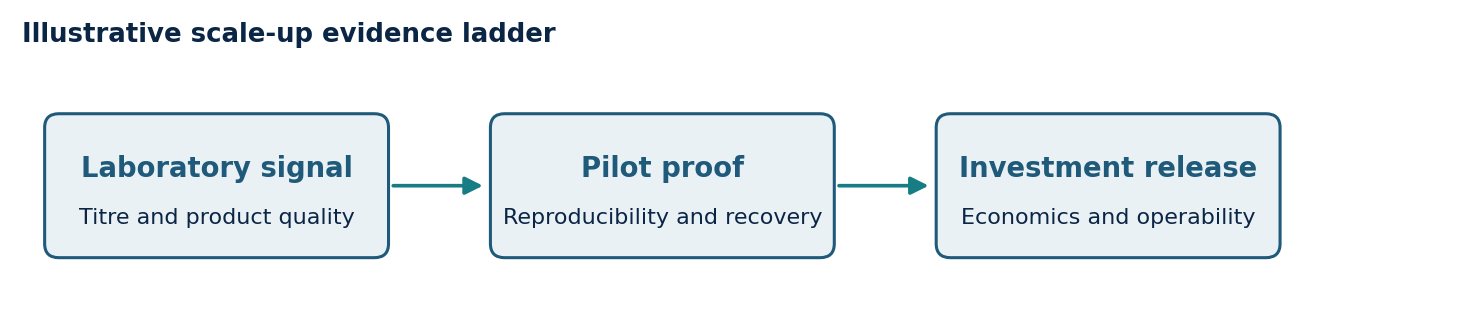
The business cannot select a scale route from titre alone. A route that looks strong in a small reactor can be constrained by mass transfer, batch consistency, downstream throughput, product specification, input economics or the operating model of the chosen manufacturing partner. The panel creates a disciplined way to challenge those linked assumptions before capacity is committed.
Panel Architecture
The panel combines strain and bioprocess development, downstream processing, food application, manufacturing operations, quality, regulatory and techno-economic perspectives. It is designed to test the handoffs that turn a culture result into a reliable ingredient operation.
Bioprocess and strain development
Tests productivity, stability, oxygen-transfer and feed-strategy assumptions.
Downstream and product quality
Challenges recovery yield, impurity control and specification at larger scale.
Manufacturing and facility operations
Assesses equipment fit, cleaning, scheduling, utilities and batch reproducibility.
Food, regulatory and economics
Connects application performance, approval pathway and cost drivers to the route choice.
Evidence Base for Discussion
The panel works from a clear separation between client evidence, external context and open questions. It is not asked to validate a marketing claim or replace the client’s own technical and regulatory accountability.
Client evidence
Laboratory fermentation and recovery data; provisional product specification; two proposed process routes; preliminary pilot partner assumptions; cost model inputs.
External context
Scale-up engineering context; food-ingredient quality and regulatory considerations; benchmark process assumptions; external input and utility context.
Open questions
Oxygen-transfer limit; strain stability; foaming; recovery bottleneck; cleaning validation; critical quality attributes; raw-material exposure; pilot availability.
What the Panel Must Resolve
Route selection
Which process route has the better chance of holding at pilot scale for the intended ingredient specification?
Scale-sensitive assumptions
Which laboratory results are most likely to change with vessel geometry, mixing, aeration or recovery throughput?
Pilot design
What run plan, analytical package and failure scenarios are needed to make the pilot decision useful?
Economic breakpoints
Which yield, cycle-time, input-cost or capacity thresholds would invalidate the commercial logic?
Quality and regulatory fit
Can the route sustain the target specification and the information needed for the intended market path?
Investment release
What evidence should permit a larger scale commitment, require route redesign or stop the programme?
Client-Ready Outputs
Scale-Up Decision Record
States the preferred process route, the basis for it and the material conditions attached to the decision.
Pilot Demonstration Charter
Defines run sequence, critical measurements, acceptance thresholds and contingency cases.
Scale-Sensitivity Register
Connects technical assumptions to the variables most likely to change outside the laboratory.
Commercial Breakpoint Map
Shows the yield, cycle-time, recovery and input-cost thresholds that determine whether the route remains credible.
August Research Perspective
This is not a broad review of precision fermentation. It is a decision forum for one ingredient process, focused on where laboratory success can fail to become a stable, economical and controllable pilot operation.
Research Sources for this Illustrative Engagement
The sources below inform the technical context and engagement design. They are not presented as client findings.
U.S. Food and Drug Administration, Biotechnology Consultation Programs for Food From Genetically Engineered Plant Varieties and Microorganisms, accessed August 2026.
National Academies of Sciences, Engineering, and Medicine, Preparing for Future Products of Biotechnology, 2020.
U.S. Department of Energy, Bioindustrial Manufacturing and Design Ecosystem: Technical context, accessed August 2026.
Let’s Discuss Your Project
If your next technical commitment depends on competing specialist judgements, August Research can design a Technical Expert Panel around the evidence, interfaces and decision gates that matter most.