TECHNICAL EXPERT PANELS | ILLUSTRATIVE ENGAGEMENT
Go or no-go review for an AI-enabled diagnostic workflow
A structured panel to decide whether product claim, data quality, clinical workflow and regulatory route are aligned for pilot deployment.
The Decision
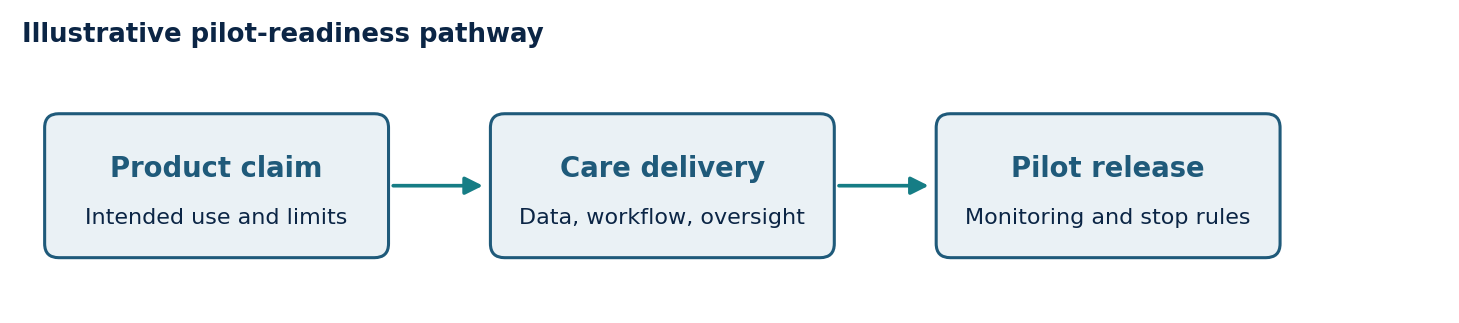
A fictional health-technology company has developed an AI-enabled workflow that flags possible abnormalities in diagnostic images for clinician review. It has retrospective model results and an interested provider network. Before a limited pilot, the company and clinical sponsor must decide whether the claimed use, data quality, clinical integration and oversight model are aligned well enough to proceed.
Illustrative Client Context
The illustrative product is intended to support, not replace, clinician judgement in a defined imaging pathway. The client has a draft user interface, a proposed intended-use statement and retrospective datasets. It lacks a shared view of pilot eligibility, workflow ownership, performance monitoring and the evidence needed if the product route changes.
Why This Requires a Technical Expert Panel
A model metric is not a pilot decision. The system must be useful at the point of care, support safe escalation, work with the available data and fit an appropriate regulatory and clinical-governance route. A panel helps expose conflicts between a product claim that appears attractive and a workflow that cannot safely sustain it.
Panel Architecture
The panel combines clinical practice, imaging operations, data science, human factors, quality and regulatory perspectives. Each participant reviews the intended-use statement, dataset characteristics and proposed workflow before independent assessment and facilitated challenge.
Clinical workflow lead
Tests clinical value, escalation and accountability in the real care pathway.
Data and model specialist
Challenges dataset representativeness, drift risk and performance measurement.
Human factors and IT integration
Assesses alerts, user burden, interoperability and failure visibility.
Quality and regulatory specialist
Tests alignment among claims, evidence, change control and oversight.
Evidence Base for Discussion
The panel works from a clear separation between client evidence, external context and open questions. It is not asked to validate a marketing claim or replace the client’s own technical and regulatory accountability.
Client evidence
Intended-use draft; retrospective performance results; dataset description; user interface concept; proposed pilot sites; draft risk controls.
External context
Relevant clinical workflow guidance; device software and machine-learning regulatory context; human-factors considerations; data governance expectations.
Open questions
Pilot population; dataset gaps; threshold selection; clinician override; false-negative escalation; integration dependencies; monitoring cadence; model-update controls.
What the Panel Must Resolve
Intended-use fit
Is the claimed role precise enough for the clinical pathway and evidence available?
Pilot readiness
Can the proposed sites operate the workflow safely without hidden workarounds or ambiguity?
Data sufficiency
Which dataset limitations affect the pilot population, and how will performance be monitored in use?
Human oversight
Who reviews, overrides and escalates outputs, including when the system is unavailable or uncertain?
Regulatory route
Which claims, evidence and change controls are compatible with the planned deployment path?
No-go conditions
What should stop the pilot or narrow the intended use before patients are exposed?
Client-Ready Outputs
Pilot Go or No-Go Record
Sets the pilot decision, intended-use boundary, material caveats and non-negotiable controls.
Clinical Workflow and Ownership Map
Clarifies alert handling, clinician review, escalation and exception ownership.
Performance Monitoring Plan
Defines pre-specified measures, subgroup review, drift signals and response actions.
Evidence and Regulatory Gap Register
Separates what is known, what must be demonstrated and what would change the deployment route.
August Research Perspective
This is not a generic AI market assessment or a clinical validation study. It is a controlled decision forum that tests whether one proposed diagnostic workflow can be piloted responsibly within a defined clinical and governance setting.
Research Sources for this Illustrative Engagement
The sources below inform the technical context and engagement design. They are not presented as client findings.
U.S. Food and Drug Administration, Clinical Decision Support Software: Guidance for Industry and Food and Drug Administration Staff, current edition.
U.S. Food and Drug Administration, Good Machine Learning Practice for Medical Device Development: Guiding Principles, 2021.
International Medical Device Regulators Forum, Software as a Medical Device: Clinical Evaluation, 2017.
Let’s Discuss Your Project
If your next technical commitment depends on competing specialist judgements, August Research can design a Technical Expert Panel around the evidence, interfaces and decision gates that matter most.