BIOTECH + CELL-THERAPY LOGISTICS
Non-Frozen Autologous Cell-Therapy Transport
Assessing whether preservation, packaging and predictive release can create a dependable 48 to 72 hour operating window.
THE R&D DECISION Should a cell-therapy developer invest in a non-frozen transport platform for fresh autologous drug product, and is the stronger opportunity a new preservation formulation, an integrated container system or a time-temperature-to-potency release model?
Project background
Autologous cell therapies move a patient-specific living product through manufacturing and clinical logistics. Cryopreservation provides scheduling flexibility, but it adds freezing, storage and thawing operations and can influence recovery or phenotype. A non-frozen route could simplify selected decentralised or point-of-care models, yet the available time window is short and patient-to-patient variability makes average viability an incomplete release argument.
Hypothermic preservation at 2 to 8°C slows metabolism but does not stop degradation. The research question must therefore connect formulation, gas and nutrient exchange, container closure, transport excursions, chain of identity and functional potency. The white space is not simply “fresh CAR-T shipping”; it is an integrated evidence framework that predicts whether a specific unit remains suitable at administration.
Technical scope
Boundary | Working definition |
|---|---|
Product boundary | Fresh autologous T-cell or CAR-T drug product in a closed final container. |
Route boundary | Manufacturing site to treatment centre over a nominal 48 to 72 hour period at 2 to 8°C. |
Quality boundary | Identity, viability, recovery, phenotype, sterility assurance and functional potency. |
Decision boundary | Whether an integrated non-frozen platform merits formulation and shipping validation. |
NOTE: The product, route and performance thresholds are hypothetical. Regulatory considerations and preservation mechanisms are based on current public guidance and scientific research. | |
WHY THE GAP MATTERS
A longer viability number is not yet a transport strategy
FDA guidance treats potency assurance as a multifaceted strategy involving process design, material controls, in-process testing and lot-release assays. FDA CAR-T guidance also emphasises uniform collection procedures, stability support and chain of identity. For a non-frozen route, these expectations make it important to understand how time and temperature affect functional attributes, not only membrane integrity at the end of storage.
The regulatory basis was checked against FDA’s Potency Assurance for Cellular and Gene Therapy Products, which recommends a science- and risk-based strategy across process and testing controls.
Product-specific expectations were checked against FDA’s Considerations for the Development of CAR T Cell Products, including CMC, manufacturing control and clinical-development considerations.
The emerging feasibility signal includes a 2026 hypothermic preservation study, which investigated clinical-grade CAR-T stability for at least 72 hours at 2 to 8°C.
Hypothetical release window
Attribute | Working gate at administration | Why viability alone is insufficient |
|---|---|---|
Viability | At least 85% | Dead-cell exclusion does not show cytotoxic function or recovery. |
Cell recovery | At least 70% of labelled dose | A viable percentage can mask a large loss in absolute cell count. |
Functional potency | Within ±20% of time-zero reference | Connects preservation to the intended biological activity. |
Excursion tolerance | One excursion of no more than 30 minutes within a defined band | Tests resilience to real handoffs without normalising uncontrolled shipping. |
REFRAMED WHITE-SPACE QUESTION Can preservation chemistry, closed packaging and time-temperature analytics be combined so that a 48 to 72 hour non-frozen route protects potency and supports a scientifically defensible administration decision? | ||
HOW THE RESEARCH WAS EXECUTED
A method built around the unresolved decision
The research treats transport as a degradation clock. It links cellular mechanisms and quality attributes to every handoff, then checks whether evidence from model cell lines, healthy-donor T cells or other cell types transfers to variable autologous drug product.
Research move | Execution | What it resolves |
|---|---|---|
1. Define the quality clock | Map viability, recovery, phenotype, exhaustion, aggregation, metabolism and potency over time. | Identifies which attribute reaches failure first. |
2. Reconstruct route conditions | Code fill, hold, pack-out, transit, customs or courier delay, receipt and administration with excursion cases. | Shows where operational variability enters the biological problem. |
3. Classify preservation mechanisms | Review metabolic suppression, osmotic and membrane support, antioxidants, nutrient management and oxygen control. | Separates formulation components by intended mode of protection. |
4. Map container mass transfer | Compare bag or vial material, headspace, gas permeability, surface-area ratio, mixing and closure. | Tests whether formulation evidence depends on the package. |
5. Challenge biological transfer | Compare cell line, healthy-donor and patient-derived evidence, plus fresh versus cryopreserved baselines. | Prevents an average viability result from being over-generalised. |
6. Design the release model | Link time-temperature history and selected in-process markers to final functional potency. | Defines the data needed for a predictive rather than purely clock-based expiry. |
Hypothetical research mechanics
Dataset component | Indicative scale | Coding emphasis |
|---|---|---|
Preservation and stability studies | 130 to 190 | Cell type, donor source, medium, container, time, temperature and potency. |
Regulatory and quality records | 25 to 40 | Potency strategy, stability, chain of identity and release controls. |
Packaging and monitoring technologies | 60 to 100 | Container, gas transfer, sensors, data integrity and excursion capture. |
Patent families | 50 to 85 | Formulation, closed systems, preservation additives and predictive models. |
METHOD NOTE: The dataset sizes demonstrate the likely scale of the work. They are not presented as counts from a completed client engagement. | ||
EXAMPLE ANALYTICAL OUTPUT
The Potency Transport Clock
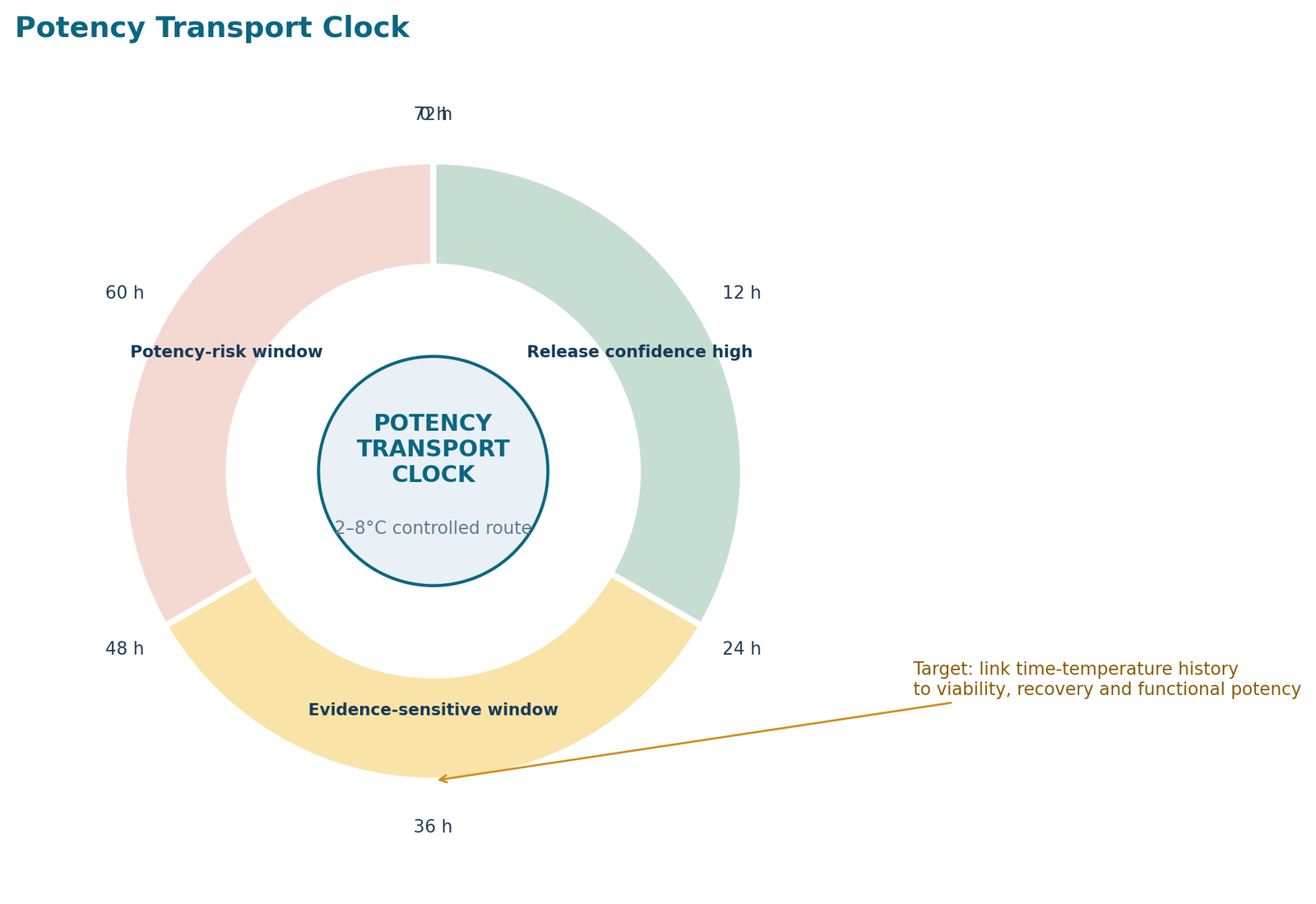
The clock combines elapsed time with the confidence available for release. It makes the operating window visible and highlights that evidence may become less transferable before a simple viability threshold is crossed.
How the output would be interpreted
- A formulation that preserves viability to 72 hours is promising only if absolute recovery, phenotype and functional potency remain acceptable across representative patient material.
- The 24 to 48 hour zone may support routine delivery, while the 48 to 72 hour zone could require tighter excursion control or an additional rapid release indicator.
- Container surface area, gas permeability and fill volume can change the biological environment and should be treated as part of the preservation platform.
- A predictive release model could create more value than a longer fixed expiry if it converts the recorded time-temperature history into a bounded potency estimate.
WEBSITE PRESENTATION SUGGESTION Present the clock as a route simulator. Visitors can add a delay or temperature excursion and see which quality attribute becomes decision-limiting. A side panel should distinguish measured release data, predicted confidence and evidence still required.
RESEARCH TERRITORIES AND DECISION
Research territories that survived the challenge review
The work narrows the broad topic into a small number of testable territories. Each territory combines a technical premise, a reason it may remain underexplored and a clear falsification condition.
Territory A | Metabolic-control preservation medium
Use a defined hypothermic formulation that limits oxidative and metabolic injury while maintaining recoverability after rewarming.
Disqualifier: Benefit is donor-dependent, masks functional loss or relies on components unsuitable for the intended product.
Territory B | Oxygen-aware closed transport system
Co-design formulation, fill volume, headspace and container permeability to control gas and nutrient conditions.
Disqualifier: Packaging variability or closure requirements eliminate the biological advantage.
Territory C | Time-temperature-to-potency release model
Combine transport logger history with selected rapid quality markers to estimate potency confidence at administration.
Disqualifier: The model cannot generalise across patient variability or lacks a stable potency reference relationship.
INDICATIVE DECISION Prioritise the integrated platform rather than formulation alone. The first investment gate should test donor variability, container effects and potency in the same stability matrix, then determine whether a predictive release model adds operational value.
DELIVERABLES AND NEXT STEP
What the project output could look like
Degradation-clock dossier
A structured view of quality attributes, failure mechanisms and evidence by time, temperature, cell source and container.
Integrated platform comparison
A comparison of formulations, packaging configurations, monitoring options and operational handoffs against the intended route.
Stability and excursion matrix
Proposed time points, donor groups, temperature excursions, viability, recovery, phenotype and functional-potency measurements.
Release-model concept
A data model linking logged transport history and rapid indicators to a bounded potency decision, with validation assumptions stated clearly.
Indicative project delivery
A focused engagement could take approximately 8 to 10 weeks. Timing depends on the therapy class, route complexity, availability of full stability studies and the breadth of formulation and packaging patents. Primary research or external expert response times would affect any later validation phase.
LET'S DISCUSS YOUR PROJECT If your team is considering fresh or non-frozen cell-therapy distribution, we can define the product-specific quality clock and route risks before deciding whether to invest in formulation, packaging, analytics or an integrated programme.
NOTE: Recommendations remain conditional on the agreed search boundary, evidence quality and client-specific performance requirements. Laboratory validation, regulatory advice and commercial due diligence would be separate workstreams where required.