MINING + CRITICAL MATERIALS
Scandium Recovery from Bauxite Residue
Testing whether residue-specific mineralogy can support a selective, lower-burden recovery route.
THE R&D DECISION Should an alumina or critical-materials company fund a new scandium-recovery programme for bauxite residue, and which hybrid leaching and separation route offers a credible advantage over established acid-intensive approaches?
Project background
Bauxite residue is a highly alkaline, iron-rich and compositionally variable by-product of alumina refining. It may contain scandium at tens of milligrams per kilogram, but low grade alone does not define the challenge. Scandium can be associated with phases that respond differently to mild leaching, while dissolved iron, aluminium, titanium and silica can increase reagent demand, form gels or overwhelm downstream separation.
The broad concept of recovering scandium from red mud is established and has reached pilot research. The narrower white space was a residue-specific hybrid route that improves selectivity and reduces the burden transferred to neutralisation, separation and final residue management.
Technical scope
Boundary | Working definition |
|---|---|
Feed archetype | Bauxite residue characterised by origin, mineralogy, alkalinity and scandium deportment. |
Process boundary | Conditioning, selective leaching, solid-liquid separation, scandium capture and purification. |
Circularity boundary | Reagent recovery, coproduct options and fitness of the remaining solids for further use. |
Economic boundary | Mass and reagent intensity considered before detailed process economics or pilot design. |
NOTE: The feed composition, recoveries and mass balance are hypothetical. Scientific mechanisms and regulatory drivers are grounded in public research and official EU materials policy. | |
WHY THE GAP MATTERS
High extraction is insufficient if selectivity and residue burden are poor
The EU Critical Raw Materials Act seeks more secure and circular material supply, while scandium remains important for specialised alloys and other applications. Public projects have already demonstrated substantial work on acid leaching, solvent extraction, ion exchange, nanofiltration and crystallisation. A defensible white space must therefore explain why a new route is better matched to a specific residue and why it reduces the total separation burden.
The strategic-material context was checked against the EU Critical Raw Materials framework, which addresses concentrated supply, substitution and recycling constraints.
The maturity baseline was checked through the EU-funded SCALE project, which developed scandium extraction from European industrial residues and downstream scandium products.
Mineralogy dependence is supported by research summarised by Germany’s BAM, showing that bauxite residues of different geological origin can exhibit strongly different leaching behaviour.
Hypothetical feed and route boundary
Input or gate | Working value | Reason for inclusion |
|---|---|---|
Scandium grade | 70 mg/kg in dry residue | Establishes the low mass available per tonne. |
Major phases | 35% Fe2O3 and 10% Al2O3 | Represents the impurity load that can dominate separation. |
Leach recovery | At least 60% with controlled Fe/Al dissolution | Prevents a high extraction result from hiding poor selectivity. |
Final recovery | At least 30 g Sc per tonne in the example route | Makes losses through each stage visible before economics. |
REFRAMED WHITE-SPACE QUESTION Which residue-specific conditioning, selective leaching and capture sequence can improve scandium recovery per unit of acid, impurity dissolved and waste generated? | ||
HOW THE RESEARCH WAS EXECUTED
A method built around the unresolved decision
The analysis begins with mineral deportment rather than a preferred reagent. Every proposed route is then followed through a mass and impurity balance so that a promising leach result cannot be separated from downstream consequences.
Research move | Execution | What it resolves |
|---|---|---|
1. Define residue archetypes | Classify origin, Bayer conditions, mineralogy, ageing, alkalinity and scandium-bearing phases. | Explains why one published route may not transfer to another refinery. |
2. Reconstruct liberation windows | Code acid, organic-acid, bioleach, pressure and ionic-liquid conditions with extraction and co-dissolution. | Shows where selectivity emerges or collapses. |
3. Quantify impurity burden | Track Fe, Al, Ti, Si, Na and major-ion loading into the pregnant solution. | Identifies separation and neutralisation penalties. |
4. Compare capture mechanisms | Assess solvent extraction, ion exchange, functional sorbents, membranes and precipitation by feed chemistry. | Tests whether leachate quality matches the separation technology. |
5. Close residue and reagent loops | Examine acid recycle, wash demand, coproduct recovery and remaining-solid use. | Prevents displacement of environmental burden. |
6. Define a route-specific experiment | Specify residue characterisation, mass balance, selectivity metrics and rejection gates. | Creates a realistic first-stage research programme. |
Hypothetical research mechanics
Dataset component | Indicative scale | Coding emphasis |
|---|---|---|
Residue and leaching studies | 160 to 230 | Origin, mineralogy, conditions, extraction and co-dissolution. |
Separation studies | 90 to 140 | Feed matrix, selectivity, capacity, regeneration and purity. |
Patent families | 55 to 90 | Integrated route, reagent loop, sorbent and coproduct claims. |
Pilot and funded-project records | 25 to 45 | Scale, feed origin, process integration and reported bottlenecks. |
METHOD NOTE: The dataset sizes demonstrate the likely scale of the work. They are not presented as counts from a completed client engagement. | ||
EXAMPLE ANALYTICAL OUTPUT
The Residue-to-Research Mass-Balance Pathway
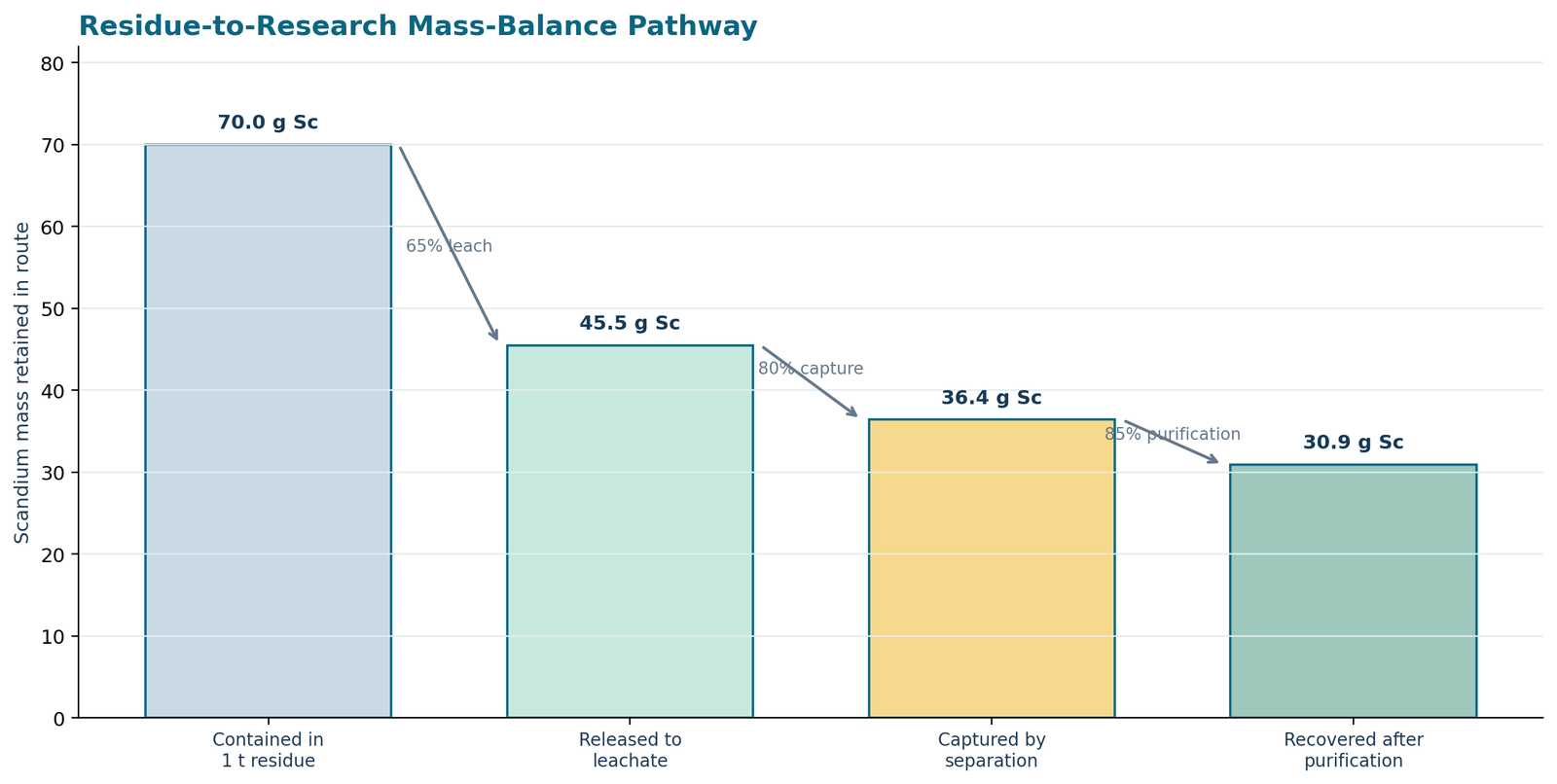
The pathway forces every percentage into an absolute quantity. Starting with a hypothetical 70 grams of scandium in one dry tonne of residue, the example applies stage recoveries to reveal how little product remains and where a small improvement could have the greatest effect.
How the output would be interpreted
- At low feed grade, a route can report a strong percentage extraction while still producing a small absolute scandium stream against a large impurity and reagent flow.
- Improving selectivity at leaching may create more value than maximising extraction if it sharply reduces iron and aluminium loading downstream.
- Bio-generated organic acids and mild conditioning may reduce mineral-acid intensity, but published work also identifies slow kinetics, biosorption and culture-medium burden as potential limitations.
- Chelating ion exchange and other selective capture methods become more credible when the pregnant solution is engineered for the sorbent rather than treated as a fixed output.
WEBSITE PRESENTATION SUGGESTION Use an interactive mass-balance pathway. Visitors can change feed grade and stage recoveries, then see recovered scandium, impurity flow and the stage with the largest avoidable loss. Keep the default values clearly labelled as a hypothetical working case.
RESEARCH TERRITORIES AND DECISION
Research territories that survived the challenge review
The work narrows the broad topic into a small number of testable territories. Each territory combines a technical premise, a reason it may remain underexplored and a clear falsification condition.
Territory A | Biological or organic-acid preconditioning
Use controlled metabolite production or mild organic acids to alter accessible phases before a short selective mineral-acid step.
Disqualifier: Long residence time, sterilisation or nutrient demand creates a greater burden than the acid saved.
Territory B | Leachate engineered for chelating capture
Tune pH, sulfate content and impurity precipitation so a selective resin or functional sorbent sees a more favourable feed.
Disqualifier: Scandium capacity or regeneration falls sharply in the real multi-ion solution.
Territory C | Coproduct-supported route
Integrate iron, aluminium, titanium or construction-material pathways so costs and residue management are not assigned solely to scandium.
Disqualifier: Coproduct quality or market volume is inadequate, or integration reduces scandium recovery.
INDICATIVE DECISION Do not begin with a universal reagent screen. Begin with mineralogical characterisation and a residue-specific mass balance, then prioritise the route that reduces impurity dissolution and downstream burden even if its headline scandium extraction is not the highest.
DELIVERABLES AND NEXT STEP
What the project output could look like
Residue archetype dossier
A comparison of relevant residue origins, scandium deportment, alkalinity and mineral phases that control transferability.
Route mass-and-impurity model
A stagewise model for scandium, Fe, Al, Ti, Si, acid, water and residue flows with adjustable recoveries.
Selective-route shortlist
Two or three integrated leach and capture routes, each with evidence maturity, limiting chemistry and a clear rejection criterion.
Laboratory hypothesis brief
Characterisation needs, leach conditions, impurity measurements, sorbent tests and mass-balance gates for a scouted mineral-processing or hydrometallurgy laboratory.
Indicative project delivery
A focused engagement could take approximately 8 to 11 weeks. Timing depends on how many residue origins are included, whether full mineralogical datasets are available and the depth of process and patent reconstruction required. Secondary research delivery remains sensitive to source access and technical response time.
LET'S DISCUSS YOUR PROJECT If your team is evaluating an industrial residue as a secondary critical-material source, we can define the feed archetype, recovery boundary and impurity constraints before deciding whether laboratory work is justified.
NOTE: Recommendations remain conditional on the agreed search boundary, evidence quality and client-specific performance requirements. Laboratory validation, regulatory advice and commercial due diligence would be separate workstreams where required.