FMCG + PACKAGING MATERIALS
Reversible Adhesives for Recyclable Flexible Packaging
Locating the research gap between package integrity during use and controlled separation during recycling.
THE R&D DECISION Should a packaging-materials company invest in a trigger-selective laminating adhesive for mono-PE or mono-PP structures, and which debonding mechanism is least likely to compromise filling, shelf life or recyclate quality?
Project background
A converter was redesigning a high-barrier pouch away from a mixed PET/aluminium/polyolefin structure. Mono-material films could improve compatibility with mechanical recycling, but the laminating adhesive still had to survive printing, pouch conversion, filling, distribution and contact with moisture, oils or cleaning agents.
The broad market for recyclable laminates is already active. The unresolved question was narrower: can an adhesive retain useful bond strength throughout the package life and then lose adhesion quickly inside a realistic recycling wash window, without leaving sticky residues or degrading the recovered polymer?
Technical scope
Boundary | Working definition |
|---|---|
Pack architecture | PE/PE or PP/PP laminate with a functional barrier and printed outer web. |
Service duty | Ambient and accelerated ageing, flexing, seal exposure, water and food-simulant contact. |
Recycling boundary | Grinding and a warm alkaline wash followed by separation, drying and reprocessing. |
Decision horizon | An 18 to 24 month formulation programme, subject to early trigger-selectivity gates. |
NOTE: The company and performance thresholds are hypothetical. The regulatory context, recycling protocols and solution mechanisms reflect current public information. | |
WHY THE GAP MATTERS
The challenge is a controlled switch, not simply a weaker adhesive
EU packaging rules increase the importance of packaging designed for recycling. CEFLEX guidance also treats adhesives as a functional but potentially limiting fraction of a mono-material pack. Current approvals show that some polyurethane laminating adhesives can be compatible with PE or PP recycling. This means that “recyclable adhesive” is too broad to be a useful white-space claim.
The policy boundary was checked against Regulation (EU) 2025/40, which establishes lifecycle requirements for packaging and packaging waste.
The design boundary was checked against the CEFLEX Designing for a Circular Economy guidelines, which address polyolefin structures, barriers, inks and adhesive compatibility.
The laboratory boundary was informed by the RecyClass PE-film laminating-adhesive protocol, which evaluates an adhesive as an innovation within a defined PE laminate.
Working performance window
Property | Hypothetical gate | Why it matters |
|---|---|---|
In-use peel retention | At least 3.0 N/15 mm after conditioning | Avoid delamination during filling and distribution. |
Triggered peel loss | At most 0.3 N/15 mm after the defined wash | Create a separation event rather than gradual package failure. |
Adhesive removal | At least 95% removal from recovered flakes | Reduce residue and stickies in the recyclate. |
Recyclate effect | No material loss in melt stability, colour or odour versus control | Ensure the trigger does not move the problem downstream. |
REFRAMED WHITE-SPACE QUESTION Which covalent, interfacial or dispersible adhesive architecture can create a wide separation between the service-stability window and the recycling-trigger window? | ||
HOW THE RESEARCH WAS EXECUTED
A method built around the unresolved decision
The analysis follows the adhesive through its full bond life, then challenges each apparent trigger against realistic recycling conditions and known failure modes.
Research move | Execution | What it resolves |
|---|---|---|
1. Reconstruct the bond life | Map coating, cure, slitting, filling, transport, shelf exposure and recycling into temperature, chemical and time conditions. | Defines conditions that must not activate the trigger. |
2. Classify trigger mechanisms | Code base-cleavable polyurethane, reversible covalent bonds, thermally expandable interfaces, hydrolysable primers and dispersible fragments. | Separates chemistry novelty from process fit. |
3. Build the switch window | Compare retained peel and triggered loss against pH, temperature, residence time and substrate. | Reveals whether a practical operating window exists. |
4. Test recycling transferability | Check whether evidence was generated on labels, rigid packs, electronics or flexible laminates. | Prevents evidence from an adjacent use being treated as directly applicable. |
5. Falsify the gap | Search approvals, patents, supplier data, food-contact limits and recyclate-quality studies. | Removes spaces already occupied or blocked by compliance. |
6. Define the first experiment | Specify laminate, trigger, residue measurement and negative controls. | Turns the surviving gap into a fundable test plan. |
Hypothetical research mechanics
Dataset component | Indicative scale | Coding emphasis |
|---|---|---|
Literature and conference records | 180 to 240 | Mechanism, substrate, trigger severity and bond response. |
Patent families | 70 to 110 | Claims around adhesive backbone, primer, additive and delamination method. |
Commercial and approval signals | 25 to 40 | Packaging structure, adhesive loading and recycling-stream compatibility. |
Protocol and policy records | 15 to 25 | Wash conditions, quality endpoints and future recyclability requirements. |
METHOD NOTE: The dataset sizes demonstrate the likely scale of the work. They are not presented as counts from a completed client engagement. | ||
EXAMPLE ANALYTICAL OUTPUT
The Bond-Life Trigger Window
This output overlays the conditions that must preserve the package with those intended to activate separation. The valuable space is not at either extreme. It is the narrow transition region where the adhesive switches rapidly without entering normal service conditions.
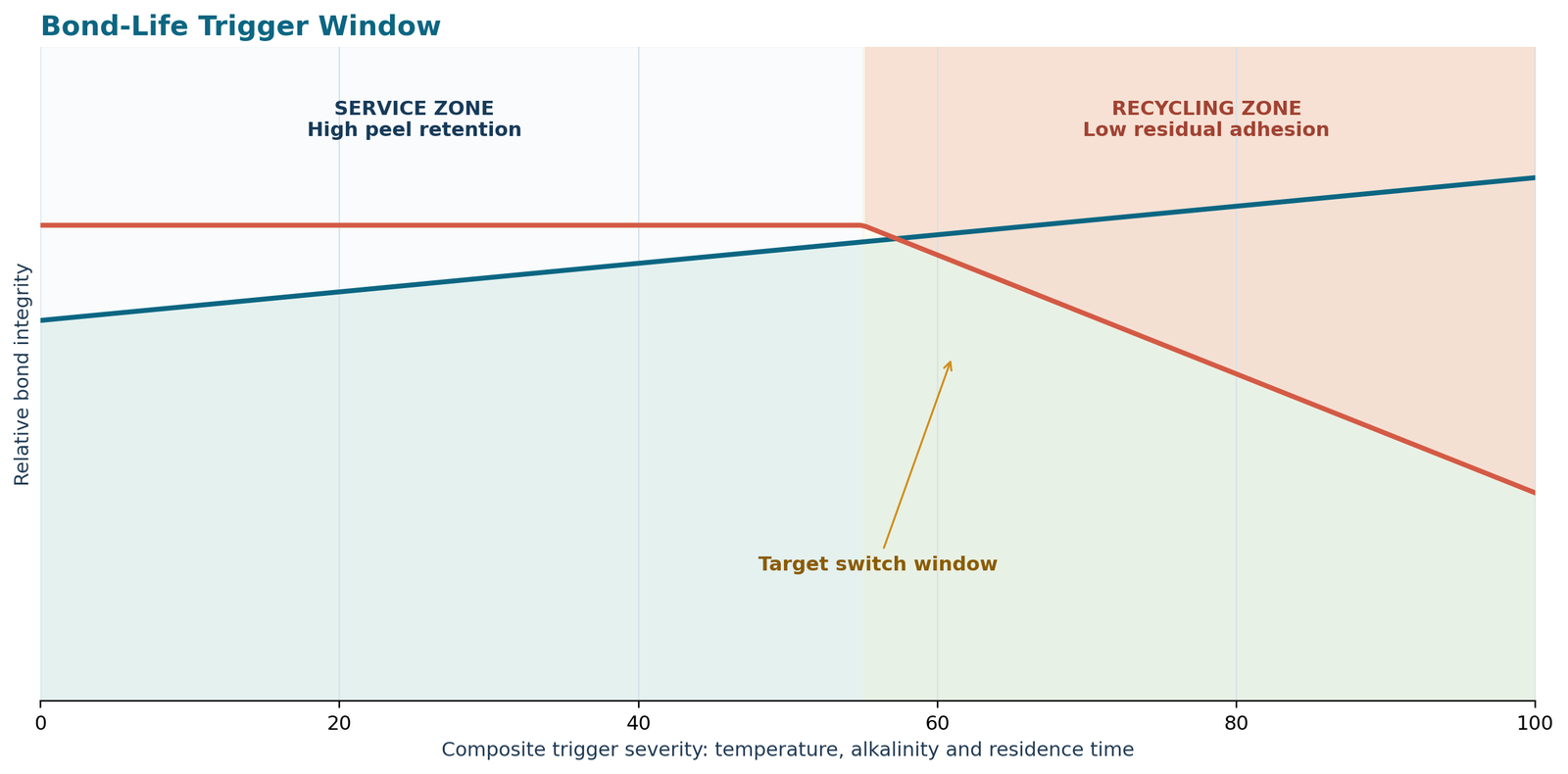
How the output would be interpreted
- A heat-only trigger above 80°C may be difficult to integrate into low-energy film recycling and could create thermal distortion before clean delamination.
- A base-cleavable chain segment has stronger process alignment because alkaline washing is already part of several recycling protocols, but hydrolysis during humid shelf life must be ruled out.
- A separate cleavable primer may protect the bulk adhesive formulation and concentrate the trigger at the interface, although primer coating adds converting complexity.
- The most useful early experiment is a paired service-versus-wash study that measures peel, residue transfer and recovered-film quality rather than peel loss alone.
WEBSITE PRESENTATION SUGGESTION Use a horizontal interactive window. Visitors can move the temperature, pH and residence-time controls to see whether a candidate mechanism remains inside the Service Zone or crosses into the Recycling Zone. Selecting a mechanism should reveal its principal failure mode and the evidence still needed.
RESEARCH TERRITORIES AND DECISION
Research territories that survived the challenge review
The work narrows the broad topic into a small number of testable territories. Each territory combines a technical premise, a reason it may remain underexplored and a clear falsification condition.
Territory A | Base-cleavable polyurethane junction
Introduce a rapidly cleavable segment into an otherwise familiar laminating-adhesive platform so the trigger is tied to alkaline wash exposure.
Disqualifier: Hydrolytic ageing reduces package peel strength or fragments remain incompatible with the recyclate.
Territory B | Triggered interfacial primer
Keep bulk adhesive performance conventional while locating reversible chemistry in a thin film-to-adhesive primer.
Disqualifier: The added coating step erases cost or process advantages, or the primer cannot be removed cleanly.
Territory C | Filterable dispersible fragments
Design the triggered adhesive to form non-tacky fragments that are removable in the recycling wash loop.
Disqualifier: Fragments pass through filtration, redeposit or materially change melt and odour performance.
INDICATIVE DECISION Prioritise a base-responsive interfacial architecture for a defined PE/PE laminate. Run the first gate as a two-sided test: prove shelf-life retention under humidity and prove rapid clean separation under the selected wash protocol.
DELIVERABLES AND NEXT STEP
What the project output could look like
White-space decision brief
A concise invest, collaborate, monitor or stop recommendation explaining why the chosen trigger window is underexplored and what could invalidate it.
Mechanism-to-duty atlas
A structured comparison of reversible chemistries, substrate combinations, trigger conditions, food-contact considerations and evidence maturity.
First-experiment specification
A test matrix covering laminate construction, cure, accelerated ageing, wash trigger, peel, residue, melt quality, odour and negative controls.
Partner and capability shortlist
Potential polymer, adhesive, converting and recyclability-testing capabilities linked to the proposed experiment. Any external laboratory would be scouted for the project rather than represented as an August Research facility.
Indicative project delivery
A focused secondary-research engagement could take approximately 7 to 9 weeks. Timing depends on the final substrate and food-contact boundary, the volume of full-text patent review and the speed with which technical sources can be obtained. Research-heavy projects remain sensitive to source availability and response time.
LET'S DISCUSS YOUR PROJECT If your team is balancing package integrity with future recycling requirements, we can define the exact laminate, duty cycle and recycling route before testing whether the apparent gap is technically open and commercially relevant.
NOTE: Recommendations remain conditional on the agreed search boundary, evidence quality and client-specific performance requirements. Laboratory validation, regulatory advice and commercial due diligence would be separate workstreams where required.