CHEMICALS + HIGH-DENSITY COMPUTING
PFAS-Free Functional Fluids for Single-Phase Immersion Cooling
Identifying the underexplored research territory beyond the broad search for a PFAS-free replacement.
THE R&D DECISION Should a specialty-fluid company fund a new research programme for high-density data-centre immersion cooling, and which unresolved combination of fluid properties offers the strongest research case?
Project background
A specialty-chemicals company was considering a new dielectric-fluid platform for single-phase immersion cooling. Its initial hypothesis was that regulatory pressure on PFAS and the growth of AI computing had created a broad white space for PFAS-free fluids. Before assigning formulation scientists and laboratory capacity, the R&D team wanted to know whether the space was genuinely underexplored or already becoming crowded.
The decision was complicated by the fact that immersion fluids must satisfy several requirements simultaneously. Low viscosity can reduce pumping energy and improve convective heat transfer, but fluid chemistry also influences flash point, oxidation stability, dielectric behaviour, polymer swelling, extraction of plasticisers, interaction with thermal interface materials and end-of-life handling. A credible research programme therefore required a narrower question than “Can we make a PFAS-free coolant?”
Hypothetical working case
System boundary
Single-phase, open-bath immersion for a future 80 to 120 kW AI rack or equivalent high-density tank segment.
Operating window
Fluid inlet of 35 to 45°C, bulk exposure up to 60°C and a working temperature rise of 5 to 12°C.
R&D horizon
A two-year exploratory and formulation programme followed by hardware-partner validation if evidence gates are met.
Strategic constraint
The research direction must be fluorine-free, scalable from accessible feedstocks and capable of a credible end-of-life route.
NOTE: The company, rack conditions, thresholds and decision horizon are hypothetical. The industry context and technical solution directions are based on current public evidence.
WHY THE QUESTION MATTERS NOW
The broad opportunity is real, but it is no longer empty
The regulatory and supply context creates urgency. The European Union is evaluating a broad PFAS restriction, while 3M announced that it would exit PFAS manufacturing, including fluorinated fluids, by the end of 2025. At the same time, commercial PFAS-free immersion fluids based on hydrocarbons and synthetic esters are already available. The research opportunity cannot therefore be defined simply as “PFAS-free.”
The regulatory driver was checked against the European Commission’s PFAS action summary, which describes the proposed EU-wide restriction and the policy focus on reducing releases at source.
The supply-side transition was confirmed through 3M’s manufacturing-exit announcement, covering fluoropolymers, fluorinated fluids and PFAS-based additives.
Why a direct substitute is technically difficult
Thermal and hydraulic performance
Specific heat, conductivity, density and viscosity jointly determine flow requirement, film behaviour, pump energy and hotspot removal.
Fire and facility safety
Flash point, fire point, volatility and decomposition behaviour influence tank design, ventilation, detection and insurance requirements.
Electrical reliability
Volume resistivity, breakdown strength, moisture tolerance and ageing products must remain controlled throughout service.
Hardware compatibility
Elastomers, cable jackets, adhesives, labels, capacitors, connectors and thermal interface materials may swell, harden, dissolve or transfer contaminants.
Fluid lifetime
Oxidation, hydrolysis, additive depletion, contamination and thermal cycling can shift viscosity, acidity and dielectric properties.
End-of-life route
Reconditioning, separation, additive replenishment, traceability and disposal may determine lifecycle cost and environmental value.
The compatibility boundary follows the Open Compute Project design guidance, which identifies interactions involving cables, EPDM seals, adhesives, heat shrink, connectors, relays and thermal interface materials.
REFRAMED WHITE-SPACE QUESTION Which PFAS-free chemistry or fluid-system architecture could meet a combined low-viscosity, high-fire-safety, dielectric-stability, hardware-compatibility and reclaimability window that is not yet supported by mature public evidence?
RESEARCH EXECUTION
From apparent gap to researchable territory
Each research move tested whether the space was genuinely underexplored or converted the surviving gap into a programme that could be funded and measured. The sequence began with the combined performance window, challenged apparent gaps and ended with hypotheses, disqualifiers and evidence gates.
Research move | How it was executed | Decision contribution |
|---|---|---|
1. Define the combined performance window | Translate the client’s rack, safety, environmental and lifecycle requirements into 14 measurable fluid and system parameters. | Prevents a single attractive property from defining the opportunity. |
2. Reconstruct the activity baseline | Classify publications, patents, products, grants, conference work and standards by fluid family, duty, temperature, test duration and hardware boundary. | Shows where activity is established, emerging or missing. |
3. Detect missing intersections | Analyse co-occurrence between chemistry and requirements such as viscosity plus flash point, compatibility plus long ageing, and performance plus reclamation. | Identifies gaps that ordinary keyword counts would miss. |
4. Challenge each apparent gap | Search alternative terminology, adjacent power-electronics and transformer-fluid fields, non-English evidence, commercial products and known trade-offs. | Removes false white spaces and hidden existing work. |
5. Separate product availability from research completeness | Treat commercial claims as signals, then check whether comparable long-duration, full-hardware and lifecycle evidence is publicly available. | Avoids assuming that product launch equals a solved research problem. |
6. Convert the surviving gaps into research territories | Define hypotheses, disqualifiers, experiment sequences, partner capabilities and evidence gates for each opportunity. | Creates an invest, collaborate, monitor or deprioritise decision. |
Hypothetical research mechanics
620 records screened
Publications, patent records, technical papers, programmes, standards and product information captured across the agreed search boundary.
148 sources reviewed in depth
Full technical records coded against chemistry, test conditions, performance, ageing and material-contact variables.
76 patent families classified
Families grouped by base-fluid chemistry, additives, immersion architecture, treatment and condition monitoring.
31 commercial or pilot signals
Products, hardware certifications, demonstrations and collaboration announcements used to challenge claims of emptiness.
METHOD NOTE: These counts demonstrate what a project dataset could look like. They are not reported as the results of a completed client engagement.
VISUAL RESEARCH OUTPUT
The Evidence-Gap Mosaic
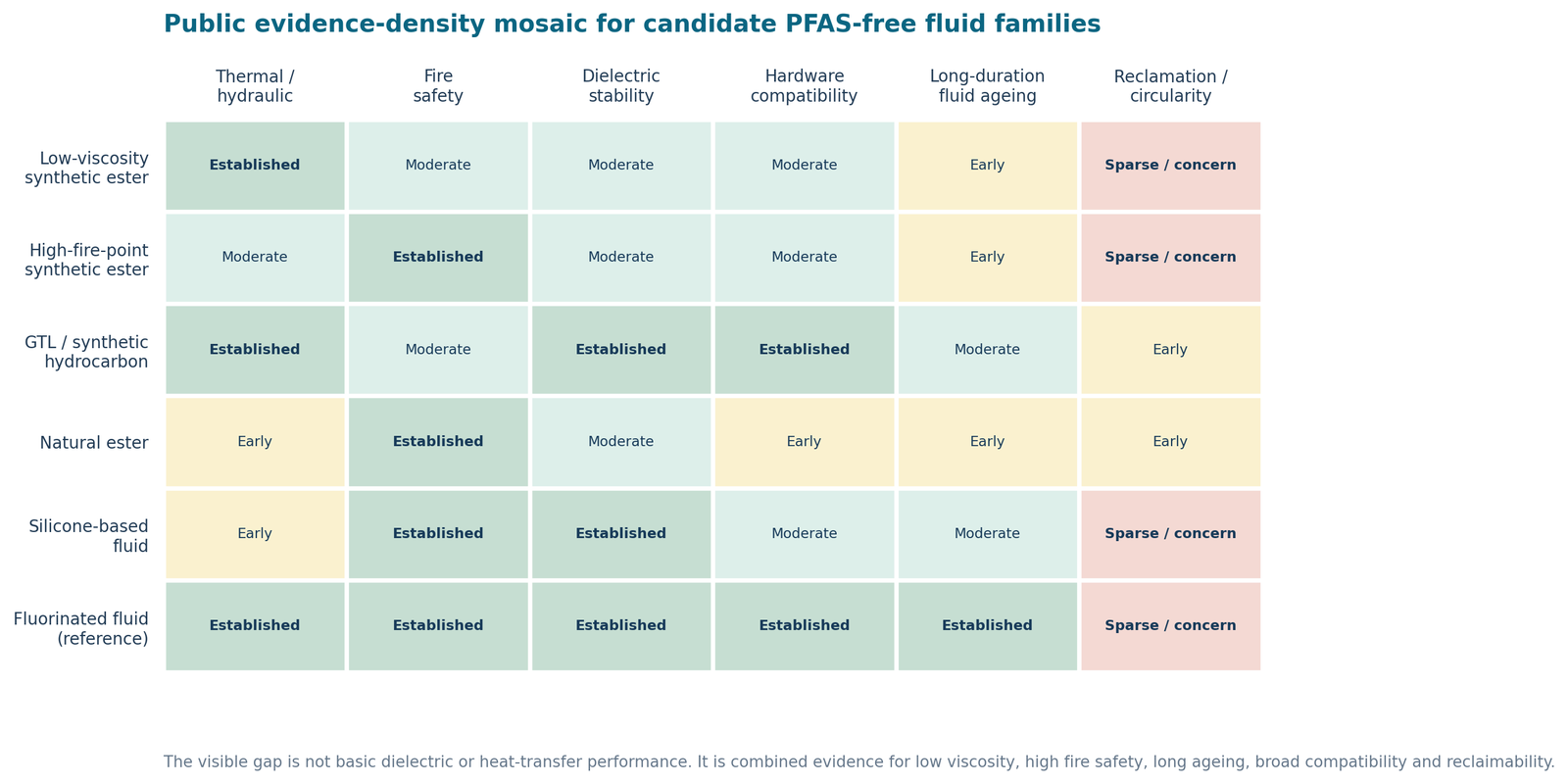
The output below does not score which fluid performs best. It shows where public evidence appears established, moderate, early or sparse for each requirement. This distinction matters because a commercially available fluid may still leave an underexplored long-duration or lifecycle research question.
What the mosaic reveals
- Basic PFAS-free heat transfer and dielectric capability is not the principal gap. Synthetic hydrocarbon and ester fluids already have experimental and commercial support.
- The evidence becomes thinner when long-duration ageing, full hardware compatibility and fluid reclamation must be demonstrated together.
- Public product positioning increasingly separates low-viscosity and high-fire-safety grades. This suggests a useful structure-property research question, although product claims alone do not prove a fundamental trade-off.
- Reclamation and condition-based fluid life extension are weaker evidence areas across most fluid families and may provide a system-level white space alongside formulation chemistry.
Recent experimental work comparing ester and synthetic-hydrocarbon PFAS-free oils found that both chemistry and viscosity influenced thermal resistance at a 40°C inlet condition. See the 2026 FAU conference paper for the underlying experimental and modelling study.
WEBSITE PRESENTATION SUGGESTION Present the mosaic as an interactive grid. Selecting a cell should reveal the evidence types available, test conditions, transfer limitations and the next experiment needed. A toggle can switch between Evidence Density, Research Priority and Client Capability Fit. On mobile, show one fluid family at a time as a horizontal evidence strip.
OPPORTUNITY TERRITORIES
Three research territories survived the challenge review
The analysis did not recommend a generic replacement-fluid programme. It identified three narrower territories where a credible scientific premise, future relevance and a measurable research path overlapped.
Territory A | Low-viscosity, high-fire-point ester architecture
Investigate branched synthetic-ester structures and tightly controlled additive systems that target low viscosity without surrendering flash point, oxidation stability, dielectric behaviour or hydrolytic control. Commercial activity confirms the relevance of both low-viscosity and high-fire-safety requirements, but comparable public evidence across the complete window remains limited.
- Research variables: alcohol and acid branching, molecular-weight distribution, polarity, antioxidant system and moisture sensitivity.
- First disqualifier: the target viscosity cannot be reached without unacceptable volatility, hydrolysis or loss of fire safety.
- Initial evidence gate: three formulation families meet the agreed viscosity, flash point and dielectric thresholds before hardware-contact testing.
Territory B | Compatibility-predictive fluid design
Move beyond testing a finished fluid against a limited component set. Build a structure-solvency and accelerated-ageing model that predicts extraction, swelling, hardness change and contaminant transfer across representative elastomers, cable jackets, adhesives and thermal interface materials.
- Research variables: Hansen-solubility parameters or equivalent descriptors, temperature, contact time, polymer formulation and contaminant loading.
- First disqualifier: compatibility depends so strongly on proprietary component formulations that a transferable prediction model is not possible.
- Initial evidence gate: predictive classification correctly separates acceptable and unacceptable material-fluid pairs in a blinded test set.
Territory C | Condition-monitored fluid reclamation
Treat fluid life as a managed system rather than a fixed replacement interval. Investigate whether acidity, moisture, viscosity, dielectric loss, dissolved contaminants and additive depletion can trigger filtration, drying, adsorption, partial rebalancing or controlled reclamation.
- Research variables: sensor or sampling frequency, degradation markers, treatment selectivity, additive restoration and batch traceability.
- First disqualifier: reconditioning creates uncertain composition or cannot restore dielectric and compatibility performance consistently.
- Initial evidence gate: at least 80% of an aged fluid batch is recoverable to the agreed property window in a controlled bench study.
THRESHOLD NOTE: All evidence gates and percentages are working examples. Final targets would be defined with the client’s formulation, safety, hardware and lifecycle teams.
DECISION AND RESEARCH PROGRAMME
Recommended R&D decision: invest narrowly
DECISION Do not fund a broad PFAS-free immersion-fluid programme. Fund a staged exploration of Territory A, with Territory B built into the validation method and Territory C retained as a parallel system-level workstream. This creates a more defensible research position than competing on PFAS-free status alone.
Proposed evidence gates
Gate | Working test | Decision rule |
|---|---|---|
G1 | Formulation screen | Measure viscosity at 20, 40 and 60°C, flash and fire point, density, specific heat, conductivity, moisture response and dielectric properties. | Advance only formulations meeting the agreed combined window. |
G2 | Accelerated ageing | Run oxygen, moisture, metal-catalyst and thermal stress conditions; track acid number, viscosity, colour, deposits and dielectric change. | Remove chemistries with unstable or difficult-to-diagnose degradation. |
G3 | Material-contact panel | Expose representative elastomers, cables, adhesives, coatings, PCBs, TIMs and optical components at elevated temperature. | Advance only when physical, electrical and contaminant-transfer limits are met. |
G4 | Thermal loop | Compare pressure drop, pump power, component temperature and heat-transfer stability under representative flow and load transients. | Confirm that low viscosity produces a system benefit rather than a property-sheet advantage. |
G5 | Reclamation trial | Age, contaminate and treat the fluid using the proposed filtration, drying or adsorption route. | Confirm property recovery, composition control and traceability. |
G6 | Hardware demonstration | Operate a representative high-density server or emulator through steady load, thermal cycling and service interventions. | Proceed to partner validation only if performance and compatibility remain inside the agreed window. |
Why this output is useful to the R&D leader
- It prevents resources being assigned to a broad theme that already contains commercial competitors.
- It identifies the specific combined requirement where public evidence remains incomplete.
- It converts white space into hypotheses, disqualifiers and measurable evidence gates.
- It separates formulation opportunity from hardware-compatibility and fluid-service-system opportunity.
- It creates a defensible basis for allocating scientists, laboratory time and collaboration budgets.
DELIVERY
Indicative project delivery
A project of this scope would typically take about seven weeks. The opening stage would define the combined performance window and reconstruct activity across scientific literature, patents, grants, standards, products and technical programmes. The middle stage would identify missing intersections, challenge false white spaces and examine relevant developments in adjacent fields. The final stage would qualify the strongest research territories, test their fit with the client’s capabilities and translate them into an R&D decision brief with proposed evidence gates.
Where required, an additional week could be used for a focused patent-family review, partner-capability assessment or test-method deep dive.
What the client receives
- A traceable research-activity register and domain taxonomy.
- The Evidence-Gap Mosaic with cell-level rationale and transfer limitations.
- A false-white-space log explaining which apparent gaps were rejected and why.
- Three to eight research-opportunity cards with premise, emerging signals, uncertainties and disqualifiers.
- An R&D priority portfolio linking each territory to explore, invest, collaborate, test, monitor or deprioritise.
- A proposed experiment sequence, evidence gates and external capability profile for the next stage.
Delivery can include a PowerPoint decision readout, an Excel research register and opportunity-scoring workbook, and a concise Word or PDF technical report. A working session with R&D, formulation, safety and hardware stakeholders can be used to challenge the thresholds before the final portfolio is issued.
TIMELINE NOTE: The timeline is indicative and depends on the chemistry boundary, patent-family depth, language coverage, availability of full technical records and the number of territories requiring detailed assessment.
Let’s discuss your project
If your R&D team sees a promising but underexplored area and needs to decide whether it deserves scientists, laboratory capacity or external collaboration, August Research can test whether the gap is real and translate it into a researchable programme.
NOTE: This engagement is a hypothetical example of the service. Industry conditions and proposed technical directions are grounded in current public information, but the company, dataset, thresholds, findings and recommendation are not presented as client outcomes.